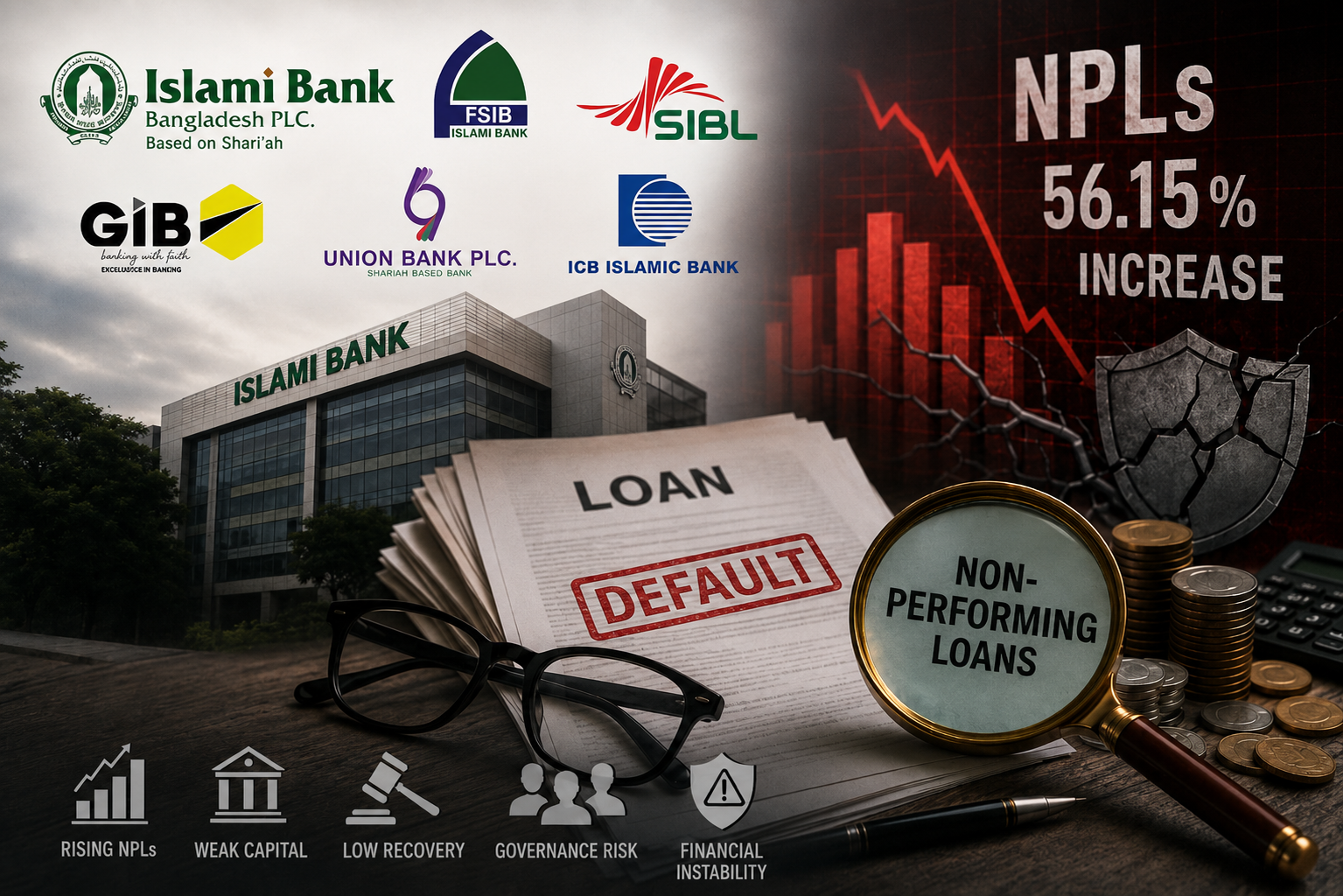

Niaz Mahmud: Bangladesh’s Islamic banking sector is experiencing significant financial stress as non-performing loans (NPLs) surged by 56.15 per cent in 2025, underscoring deepening vulnerabilities in asset quality and raising concerns about the segment’s stability, according to recent central bank data.
According to the latest Financial Stability Report 2025, which was released by Bangladesh Bank, the overall banking sector is facing mounting pressure as the ratio of non-performing loans surged to 30.60 per cent, highlighting deep-rooted weaknesses in loan management, corporate governance, and recovery mechanisms.
The latest data indicate that nearly one-third of all outstanding loans in the banking system have become classified, reflecting a significant deterioration in asset quality. Economists and banking experts warn that the sharp rise in default loans could undermine financial stability, constrain credit growth, and weaken investor confidence in the country's financial sector.
Industry analysts attribute the growing NPL burden to a combination of factors, including weak credit appraisal practices, poor corporate governance, prolonged legal disputes, repeated loan rescheduling facilities, and a lack of accountability among willful defaulters. Economic challenges, including high inflation and slower business growth, have also affected borrowers' repayment capacity.
Experts argue that the current NPL ratio is one of the highest in the country's history and poses a serious challenge to the health of the banking system. They stress that without effective recovery measures and structural reforms, the problem could continue to worsen in the coming years.
The sharp rise in defaulted loans reflects increasing repayment pressure on borrowers amid a challenging macroeconomic environment, tighter liquidity conditions, and weaker business performance across key financing sectors. The surge has placed additional strain on Islamic banks’ balance sheets, affecting profitability and capital adequacy.
A major concern highlighted by analysts is the rapid deterioration of capital strength within the sector. The Capital to Risk-Weighted Assets Ratio (CRAR) of Islamic banks has dropped significantly into negative numbers, showing that their financial safety net has weakened a lot, as more bad loans mean they have to set aside more money for potential losses.
The 56.15 per cent increase in bad loans has also significantly reduced the Islamic banking sector’s earnings capacity. Islamic banks are now allocating a larger share of income toward loan loss provisions, leaving limited space for profit generation and new investment. This has slowed credit flow to key sectors such as trade, SMEs, and consumer financing.
Experts attribute the rising NPL burden to a combination of structural and operational weaknesses, including inadequate credit appraisal, weak monitoring of large exposures, delayed recovery mechanisms, and concentration of risk in a limited number of corporate borrowers. Broader economic pressures, including inflation and slower business growth, have further aggravated repayment difficulties.
Stress testing results indicate that Islamic banks are particularly vulnerable to further shocks in credit quality. Any additional rise in default loans could lead to deeper capital erosion and potentially push more institutions below regulatory thresholds, increasing systemic risk concerns for the broader financial system.
Despite these challenges, Islamic banking continues to hold an important position in Bangladesh’s financial sector, with a growing share of deposits and financing activities. However, the recent spike in NPLs has reversed earlier stability gains and pointed out the urgent need for stronger risk management practices.
Bangladesh Bank has intensified supervisory oversight of Islamic banks, focusing on improving loan classification, strengthening compliance, and enhancing governance standards. Regulators are also pushing for faster recovery of defaulted loans and stricter monitoring of high-risk exposures.
Financial analysts emphasise that addressing the 56.15 per cent surge in NPLs will require coordinated action, including legal reforms to accelerate loan recovery, improved credit risk frameworks, and stronger accountability mechanisms for willful defaulters.
With asset quality deteriorating rapidly, the Islamic banking sector now faces a critical test. Its ability to contain rising NPLs and rebuild financial buffers will be key to ensuring long-term stability and maintaining confidence in Bangladesh’s banking system.
As of 2025, Bangladesh has 10 full-fledged Islamic banks, along with Islamic banking windows and branches operated by conventional banks, making the sector a major component of the country’s financial system. Despite its rapid growth in deposits and investments, the sector is now facing rising financial instability.
The role of ownership concentration has also come under scrutiny. Several reports and market analyses indicate that institutions linked to S. Alam Group have held significant influence over multiple Islamic banks in recent years. This concentration has raised concerns about risk exposure, governance independence, and the quality of lending decisions within affected banks.
Recent data show that Islamic banking has continued to expand in scale, with deposits reaching around Tk 4.81 lakh crore by end-2025, accounting for roughly a quarter of the total banking sector deposits. However, this expansion has been accompanied by growing concerns over asset quality and governance weaknesses in several institutions.