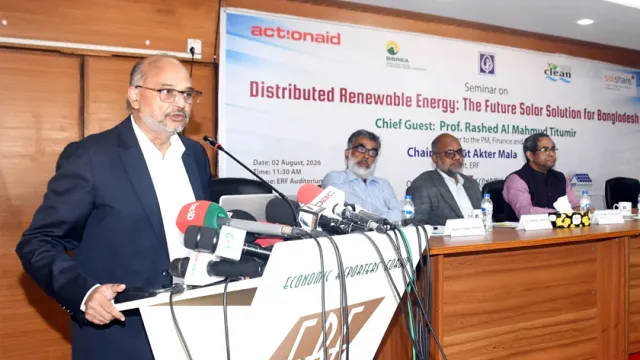

Staff Correspondent: Distributed renewable energy (DRE) can become the backbone of Bangladesh's power sector, but only if the country builds a predictable policy framework, dedicated financing windows, and energy storage into its plans "from Day 0," speakers said at a joint press briefing organised by the Economic Reporters' Forum (ERF) and the Distributed Renewable Energy Platform (DREP) at the ERF Auditorium in Paltan Tower.
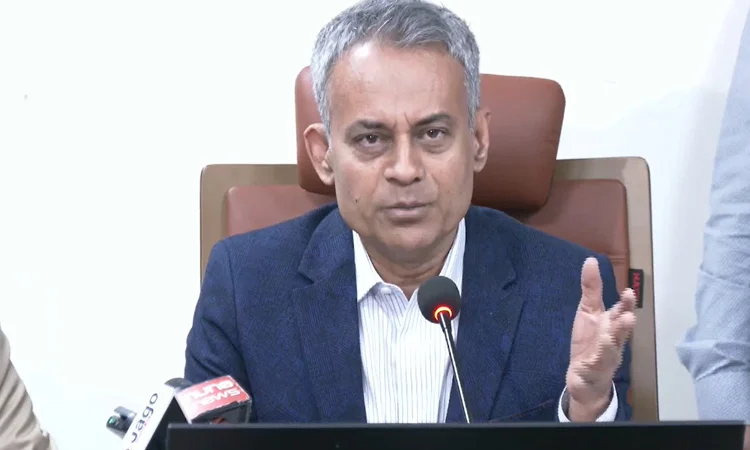
Prof Rashed Al Mahmud Titumir, Adviser for Finance and Planning to the Prime Minister, attended as chief guest at the event, which also marked the launch of a new public resource, the "Renewables in Bangladesh" website, along with the concluding initiative of the DREP platform, which brings together the Centre for Policy Dialogue (CPD), ActionAid Bangladesh, SOLshare, the Bangladesh Sustainable and Renewable Energy Association (BSREA), and the Coastal Livelihood and Environmental Action Network (CLEAN).
Presenting CPD's findings, speakers noted that Bangladesh's earlier off-grid Solar Home System (SHS) drive, which peaked at 853,000 annual installations in 2013, collapsed to just 3,455 by 2018 as the national grid expanded faster than any transition plan for existing users. Nearly 47 percent of installed SHS units are now non-functional, according to a 2025 CPD survey, leaving millions of "stranded solar assets" across the country. On-grid rooftop solar, by contrast, is scaling steadily, with 4,551 net-metering installations generating 213.3 MW of capacity, concentrated heavily in Dhaka division.
BSREA highlighted regulatory and market bottlenecks facing engineering, procurement and construction (EPC) firms, including inconsistent interpretation of tax and duty rules, multiple overlapping approval processes, and a shortage of certified technicians. CLEAN's presentation, drawing on the "SUNED" campaign, argued that the residential sector—consuming 57.2 percent of national electricity—could become the largest demand-side contributor to decarbonisation, with the potential to install at least 8,600 MW of rooftop capacity by 2030 if just 10 percent of the country's 40.3 million households adopt small systems.
SOLshare's presentation focused on energy storage, warning that Bangladesh's electricity demand peaks around 9:00 PM, hours after solar generation tapers off. With the Rooppur nuclear plant's inflexible 2.4 GW baseload coming online, speakers said storage—both grid-scale battery systems and a distributed "virtual power plant" built on six million electric three-wheeler batteries—would be essential to avoid the kind of storage-less solar boom seen recently in Pakistan, where a rapid rooftop surge without matching storage investment strained the grid and triggered an emergency battery build-out.
ActionAid Bangladesh's session on financing noted that meeting the Renewable Energy Policy 2025 target will require up to US$980 million annually until 2030, rising to US$1.46 billion per year in the following decade, while renewable energy currently makes up just over 5 percent of installed capacity. High collateral requirements, currency risk, and a fragmented regulatory landscape across IDCOL, Bangladesh Bank and SREDA remain key barriers, particularly for households, small enterprises and marginalised groups.
The briefing closed with a set of joint recommendations: establishing a unified, SREDA-led DRE coordination body; launching a single-window digital approval platform; extending fiscal incentives across the entire solar supply chain rather than select project types; introducing dedicated green financing and credit-guarantee mechanisms; and mainstreaming storage and rooftop solar into ongoing government infrastructure programmes rather than treating them as standalone initiatives.
"Bangladesh needs an inclusive, predictable and quality-driven framework to convert policy ambition into operational DRE capacity," organisers said in their closing message, urging coordinated action from government, financial institutions, development partners and the private sector to scale distributed renewable energy nationwide.