
TBT DESK
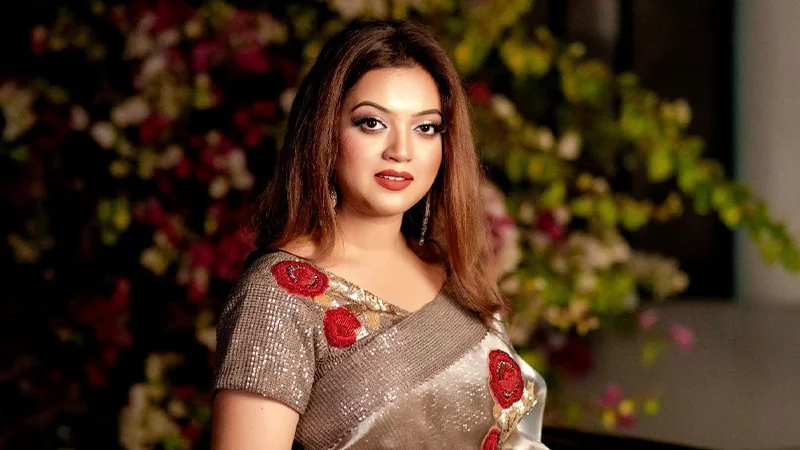
Zakiya Sultana Kornia is a familiar name in the Bangladeshi music arena. Alongside her singing career, she is serving as a judge on the reality show RTV Little Star Season 2. The singer is also keeping busy with her own music, regular practice and stage performances.
In a conversation with The Bangladesh Today correspondent, Cornia discussed her experience as a reality-show judge, the potential of young singers, her recent releases and her plans for the future.
You are serving as a judge on RTV Little Star Season 2. How has the experience been?
This is nothing quite like doing something for the first time. Serving as a judge for such a major production has been a unique experience for me. Sitting on the judges’ panel has taught me a lot. When the organisers place their trust in me, I try to fulfil the responsibility to the best of my ability. I want to evaluate each contestant’s singing fairly, without being influenced by their emotions or other factors.
Veteran pop singer Ferdous Wahid and singer Liza are also on the judging panel. Outside the shooting sessions, Ferdous Wahid kept us entertained. It never felt as though he was much older than us. The finale is scheduled for October 18. I am grateful to RTV for giving me the opportunity to be part of such an initiative.
You first came into the spotlight through a reality show. Does sitting on the judges’ panel bring back memories of those days?
Absolutely. There was a time when I, too, tried to prove myself through a competition. Drawing on that experience, I understand how important this period is for a contestant. Even a single comment from a judge can have a profound impact on them.
That is why I want to point out contestants’ strengths alongside their mistakes. It is important to explain where they need to improve and how they can do better. Encouraging young contestants is especially important because, at that age, they are not only learning music but also building self-confidence. I believe many of them can do well in the future with proper guidance and regular practice.
What potential do you see among the young contestants?
I see extraordinary talent in many of them. Some have remarkably melodious voices, while others pick up tunes with ease. But singing well is not enough; they also need a genuine interest in learning music and a commitment to regular practice.
Beyond performing well in a competition, they must learn to love music itself. I want them to take their musical journey seriously from the beginning and keep working to improve their skills. We have many talented children in the competition who sing beautifully, and I see considerable promise in them.
Some believe that singers who emerge from reality shows struggle to establish themselves later. What is your view?
Many contestants on reality shows here come from middle-class families, whose members often have great hopes for them. Initially, these contestants work very hard, but many fail to maintain that level of practice in the years that follow. Yet there is no substitute for regular practice in music.
Doing well in a competition is not the end of the journey; it should be the beginning of further growth. There will be obstacles, and success may not come as quickly as expected. But that is no reason to give up. You have to remain committed to your dream. I believe that consistent practice, patience and perseverance can eventually help anyone establish a place for themselves.
How has the response to your song Jamdani Shari been?
It has been a pleasure to receive so much love from listeners for the song. As an artiste, I always enjoy seeing how audiences respond to a new release. Their appreciation inspires me to take on new projects. I want my music to bring them joy and offer something different with every new song.
You present yourself differently at various events. Is there a particular plan behind your identity as a versatile artiste?
From the beginning of my career, I have wanted to build my identity through different kinds of songs. I enjoy challenging myself through music and discovering new sides of my artistry. I do not want to keep doing the same kind of work repeatedly.
However, experimenting does not simply mean doing something different; it is also important to do justice to the song. Whatever genre I explore, I try to preserve my own distinctive vocal style.
What are you currently busy with?
I am planning to release some new solo and duet songs, and I hope listeners will enjoy them. I am also busy with stage shows. Performing live in front of an audience is always a special experience.
I have already performed at a concert in Khagrachhari, and I had another concert in Cox’s Bazar on Wednesday. There are also a few events lined up in Dhaka. Concerts allow me to connect directly with listeners. My days are filled with new music, regular performances and opportunities to work across different musical genres.
Is there a possibility of seeing you as a model or actress alongside your singing career?
That is unlikely to happen. I have worked as a model for fashion pages in various newspapers and magazines, but mostly at their request. I never pursued modelling as a career, and I have no particular plans to act either.
I may explore other things as a hobby, but I want my primary identity to remain that of a singer. Music is my passion, and I want to move forward with it.