
Varun Chakravarthy bowled his full four overs against Afghanistan in Delhi, felt his side tighten, and was sent to the Centre of Excellence in Bengaluru, his second injury in two months. The cricket schedule 2026 has asked India national cricket team players to win a World Cup, play an IPL, tour England, and chase Asian Games gold, and the Board of Control for Cricket in India must now protect them.
The India cricket schedule 2026 has been the most crowded in years, and the T20 Cricket World Cup 2026 points table was only the start. Every rotation decision affects which India national cricket team players are fresh for the next series, and this article breaks down where the pressure points sit and what a smarter policy should look like. Big tournaments also bring a spike in searches such as “aviator game india”, but since the Promotion and Regulation of Online Gaming Act, 2025 came into force, real-money online games are banned in India, so fans are better off following the cricket than the crash games.
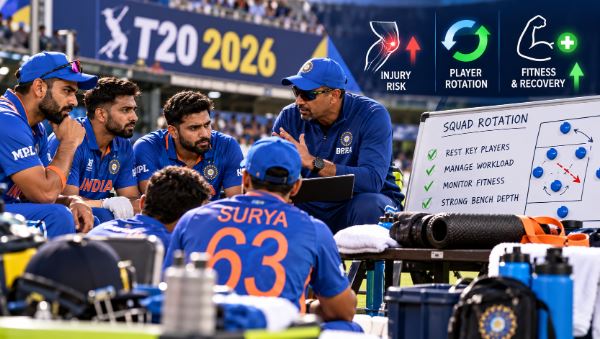
More matches mean more overload injuries, especially for fast bowlers and wrist spinners. Rotation spreads the load across a wider pool, which keeps key players available for the games that decide India national cricket team standings and trophies.
India's year has stacked one competition on top of another: the T20 World Cup from 7 February to 8 March, the IPL straight after, an England tour in July, a T20I series against Afghanistan in September, and the Asian Games in Japan, with state competitions, from the Tamil Nadu Premier League to Punjab's own Punjab T20 cricket league, filling the gaps for fringe players.
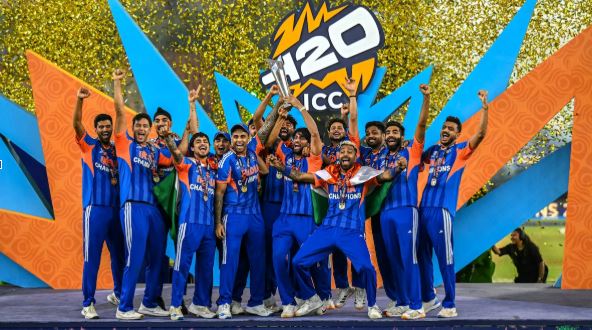
The 2026 World Cup, co-hosted by India and Sri Lanka, had 20 teams split into four groups of five. Each side played four group matches, and every result fed the T20 Cricket World Cup 2026 points table that decided who moved on. Pakistan's matches were staged in Sri Lanka, so the Pakistan cricket T20 World Cup campaign added extra travel to the co-hosts' logistics.
A win earns 2 points and a no result 1. When teams finish level, net run rate separates them first. For India, that meant every heavy win also mattered for the margin, which is one reason coaches rarely rest stars in group games.
The top two from each group reached the Super 8, split into two groups of four. Each team played three more matches, with the top two in each group going through to the semi-finals. Seven high-stakes games before the knockouts left very little room to rotate.
The semi-finals were played on 4 and 5 March and the final on 8 March. India beat England by seven runs in Mumbai and then New Zealand by 96 runs in Ahmedabad, with three days between the matches. That is a short window for fast bowlers to recover.
The clearest example of congestion came in September, when India named an Asian Games squad while Kuldeep Yadav was earmarked for ODIs against the West Indies at the same time. With two squads running in parallel, every injury becomes a selection problem. The Indian cricket team schedule for the rest of the year is published on the official BCCI website.
The most common myth is that rotation always weakens the XI. In reality, India won the World Cup with Varun Chakravarthy and Jasprit Bumrah sharing the tournament's wicket lead on 14 each, and both have since needed careful management. Chakravarthy recovered from a Grade 2 hamstring injury suffered in England, returned through domestic cricket, then picked up a side strain in his first international appearance back. A BCCI source said that "Varun is out for an indefinite period of time", and Vipraj Nigam replaced him for the Asian Games.
At ICC events, squads must be submitted by a fixed deadline. After that, any change needs the approval of the tournament's technical committee, normally backed by medical evidence. Teams cannot rotate freely once the event starts, so workload planning has to happen before the squad is named. The full playing conditions are published by the International Cricket Council.
A bowler in form can still be close to his load limit. Selection panels should track form, such as wickets and economy, separately from workload, such as overs bowled, sprint volume and recovery scores. Mixing the two is how Indian cricket team players end up rushed back, as Chakravarthy's double setback showed.
For players, rotation means fewer chronic injuries and longer careers. For broadcasters and fans, it means fewer star names in some bilateral games, but stronger teams when the trophies are on the line. Six measures would make it work:
India's depth is the reason they won a World Cup and Asian Games gold in the same year. The Board of Control for Cricket in India should turn informal rotation into a written protocol based on medical data, so that every cricket match India plays is approached with players who are fit, not just available.
| Stage | Dates | Participants | What it decides |
| Group stage | 7 Feb - late Feb 2026 | 20 teams, 4 groups of 5 | Top two per group reach Super 8 |
| Super 8 | Late Feb - early Mar 2026 | 8 teams, 2 groups of 4 | Top two per group reach semis |
| Semi-finals | 4-5 Mar 2026 | India, England, New Zealand, South Africa | Two finalists |
| Final | 8 Mar 2026, Ahmedabad | India vs New Zealand | India won by 96 runs |
Nine: four group games, three Super 8 matches, a semi-final and the final. Rotation is limited at that point, because every match after the group stage can end a campaign.
It ran from 7 February to 8 March 2026 in India and Sri Lanka, finishing just before the IPL, which made the transition into the domestic season one of the tightest in the calendar.
The top two in each group of five advance. Teams earn 2 points for a win and 1 for a no result, with net run rate as the first tie-breaker. Standings update after every match.
The ICC replacement process still requires approval and medical evidence. The bigger change is in debate rather than rules: after Chakravarthy's repeated injuries and Bumrah's long recovery, pressure is growing for a formal BCCI workload policy across formats.