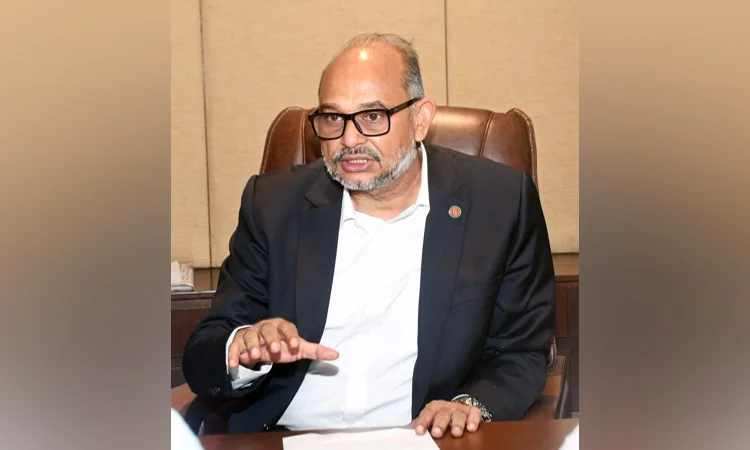

Prime Minister's Adviser on Finance and Planning Prof Dr Rashed Al Mahmud Titumir today said international development partners have expressed confidence in the government's strategy to revive Bangladesh's fragile economy inherited from the previous administration.
"Discussions with the World Bank, IMF, US Treasury Department and other multilateral development institutions had reflected a shared understanding of the country's economic challenges and the government's approach to addressing them," he said.
The adviser made the remarks while speaking to journalists on the sidelines of the annual meetings of the International Monetary Fund (IMF) and the World Bank Group here.
Titumir said the discussions had established a consensus on three key issues: the government had inherited a fragile economy and was addressing its weaknesses through transparency and accountability; it was pursuing measures to tackle fresh inflationary pressures stemming from the Middle East crisis; and its programmes for economic recovery, banking sector reform and poverty reduction were considered realistic by international partners.
"We are addressing the problems with transparency and accountability instead of sweeping them under the carpet. We have our own strategy, and international partners have developed confidence in that strategy," he said.
The adviser said the government was holding discussions with the World Bank, IMF, Asian Development Bank (ADB), Islamic Development Bank, China Exim Bank and various US assistance agencies to secure financing for its reform programmes.
He expressed hope that progress on the required financing would be made through negotiations over the next two to three months.
Titumir said protecting ordinary people from inflationary pressure remained a major government priority alongside economic recovery.
Higher fuel prices amid the Middle East crisis could raise transportation and production costs, eventually affecting the prices of essential commodities, he said.
The government had taken various measures to contain inflationary pressures and ease the cost-of-living burden on low-income people, he added.
He said the Family Card and Farmers Card programmes announced by the Prime Minister had received appreciation from international partners.
These initiatives would help support families and farmers affected by rising prices and reduce the risk of further deterioration in poverty, he added.
The government aimed to ensure that the burden of external economic shocks did not fall entirely on ordinary people, he said.
Titumir added that economic recovery involved not only managing immediate crises but also creating jobs, increasing investment, strengthening banks' financial positions and achieving long-term growth.
The adviser said a major objective of the government's reform programme was to increase the tax-to-GDP ratio without raising tax rates.
He attributed the country's tax-to-GDP ratio of below seven percent to weaknesses in tax administration, including patronage and oligarchic practices under the previous administration.
The government was working to make the tax system more transparent, taxpayer-friendly and technology-driven, he said, adding that digital transformation was under way across different levels of tax administration.
Expanding the tax net, preventing tax evasion and ensuring administrative transparency would help increase revenue without raising tax rates, he said.
Regarding the separation of tax policy formulation from revenue collection, Titumir said a committee formed to examine the issue had already submitted its report.
The government had agreed in principle to the reform and was moving towards implementing it through an executive order, he added.
Titumir said the government had specific plans to restore discipline in the banking sector, reduce non-performing loans and strengthen banks' balance sheets.
Time-bound measures were being taken to rebuild the financial foundations of banks weakened by past irregularities, he said.
Customers of Sammilito Islami Bank had started receiving their money back, while the government had also taken steps to ease potential financial pressure on depositors.
The initiatives were aimed at restoring confidence in the banking sector, he said, adding that international partners had expressed confidence in the government's strategy and timeline for the reforms.
On monetary policy and central bank independence, Titumir said the government was emphasising coordination between fiscal and monetary policies without directly interfering in the Bangladesh Bank's operations.
He said creating an environment conducive to higher investment and production was as important as controlling inflation.
The government had outlined a special financing package of around Tk 60,000 crore to help restart closed factories and increase credit flows to the private sector, he said.
The package was expected to boost investment, revive productive activities and create employment opportunities.
Titumir said Bangladesh Bank was working to restore stability in the banking sector through its own strategies and institutional mechanisms.
Maintaining the central bank's independence while coordinating economic policies would be important for rebuilding confidence in the financial sector and increasing the flow of funds to private investment, he added.
The adviser said the government's reform agenda had been designed in line with Bangladesh's own needs and political commitments rather than being imposed from outside.
The reform outlines covering taxation, banking, investment and economic governance had been included in the government's election manifesto, he said.
"We want the ownership of reforms to remain with our political authorities. Reforms are not something to be imposed from outside; we have developed our own strategy based on the needs of the country," he said.
He added that the government's five-year economic strategy and reform plans reflected this approach.
Political commitment, identification of structural weaknesses and implementation of reforms within specific timelines had helped build confidence among international partners, he said.
Titumir said the ongoing Middle East crisis had created additional pressure on Bangladesh's economy, particularly through higher fuel prices and their potential impact on transportation, production and essential commodity prices.
Financing programmes from the World Bank, ADB and Islamic Development Bank were helping address pressures in the energy sector, and discussions were underway to maintain the support and increase financing where necessary, he said.
Referring to a recent World Bank report, the adviser said around 8 million people had fallen below the poverty line amid inflationary pressure.
He said social protection, job creation and greater investment in productive sectors could help reverse the situation.
Employment generation and social safety-net programmes had played important roles in reducing poverty in Bangladesh in the past, he said, adding that the government wanted to advance job creation and social protection simultaneously.
Titumir said discussions with representatives of the US Treasury Department had also covered Bangladesh's inherited economic weaknesses and the impact of recent external shocks.
Representatives of the World Bank, treasury departments of different countries and multilateral institutions had acknowledged the role of previous economic weaknesses and the international situation in shaping the current challenges, he said.
The government would continue negotiations with development partners and other institutions to secure the financing needed to implement its recovery and reform programmes.
He expressed confidence that the ongoing discussions would make progress over the next two to three months, helping advance economic recovery, structural reforms, investment and social protection programmes.