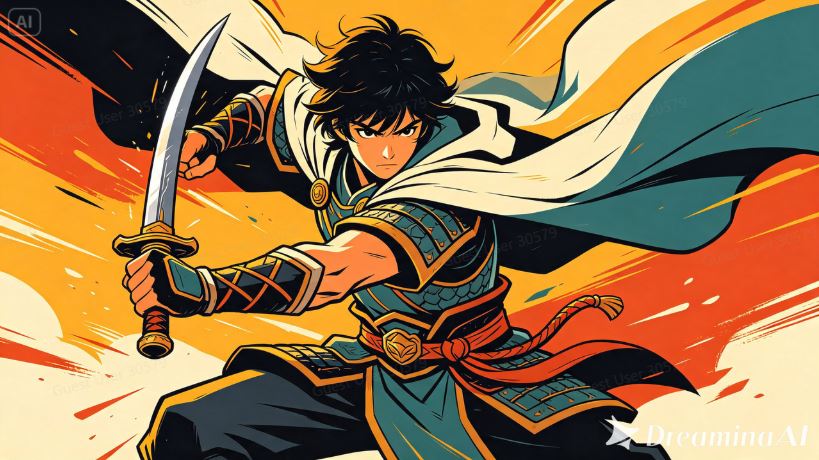

A character design sheet is full of potential energy — a pose that suggests a personality, an expression that hints at a whole backstory, a silhouette built to be recognized instantly. What it's missing is a world to move through. That's where image to video tools step in, taking a character that's only ever existed on a flat page and placing them into a living, breathing scene.
Dreamina, running on Seedance 2.5, its latest and most advanced video generation model, gives character designers a direct route from concept art to cinematic motion.
Concept artists spend enormous effort building personality into a single static pose — the tilt of a head, the swagger in a stance, the way fabric might fall. All of that detail is really just a promise of movement that never got fulfilled on the page. Animating a character design isn't adding something foreign to it; it's finally delivering on what the design was hinting at all along.
There's a real difference between a character standing in front of a plain background and a character existing inside a scene. Once a design starts moving — glancing over a shoulder, shifting weight, reacting to something offscreen — it stops reading as artwork and starts reading as a moment from a story the viewer wants more of.
Not every character needs a dramatic action sequence to feel alive. A quiet scene — a character simply breathing, blinking, adjusting their stance — can carry just as much personality as a big cinematic moment, sometimes more, because subtlety tends to reveal character just as effectively as spectacle.
Sign in to Dreamina and open the "AI Video" section. Click "Add reference image" to upload your character design, then write a prompt describing the scene and motion you want built around them.
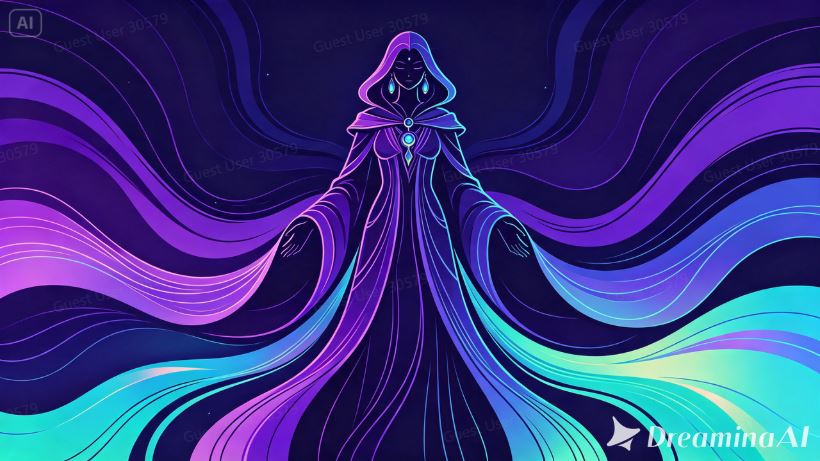
For a 30-second clip, try: Using the warrior character and pose from the reference image, generate a 30-second animated scene: the character slowly turns to face the camera, cape billowing in the wind, dust and embers drifting through the air, camera slowly circling them, dramatic lighting shifting as they raise their sword in the final seconds.
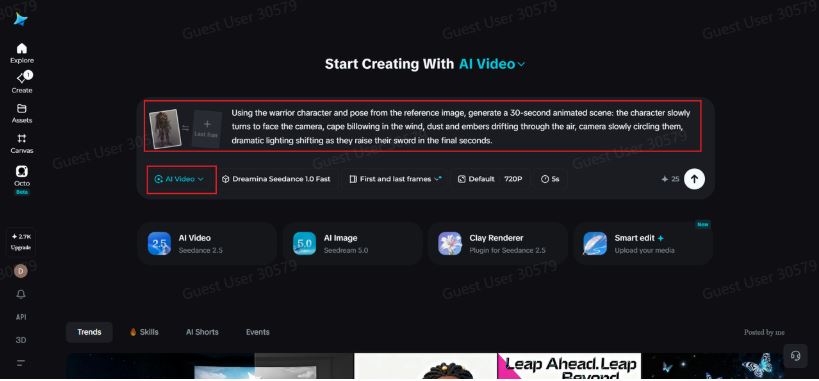
Select the Seedance 2.5 model, set your video length, then choose an aspect ratio suited to where the clip will live — 16:9 for a portfolio reel or YouTube, 9:16 for TikTok or Instagram. Click Dreamina's generate icon and let it bring the character to motion.

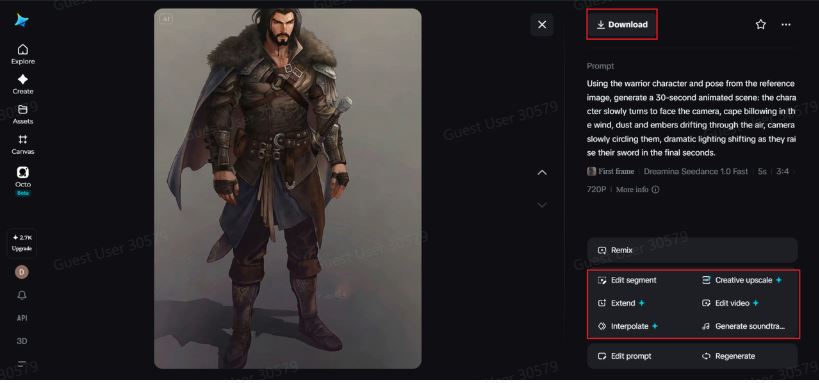
Use Dreamina's editing tools to finish the piece — Upscale for cleaner linework and detail, Generate soundtrack for music or ambient sound that matches the scene's tone — then export and share your character with the world.
Unlike a landscape or object, a character has to stay recognizably themselves across every frame — same proportions, same face, same silhouette. Any drift in consistency breaks the illusion instantly, which makes character animation one of the more demanding use cases for any video generation model.
One of the most common frustrations in AI-generated character scenes is a single subject splitting into look-alike duplicates due to spatiotemporal inconsistency. Seedance 2.5 specifically addresses this, helping a character stay singular and consistent throughout an entire clip.
The model can interpret richer references, including green screen and white model (blockout) footage, which is especially useful for capturing precise character interactions or movement paths that would be difficult to describe in words alone.
Native generation supports clips up to 30 seconds, with the "Ultra-long Video Generation (beta)" mode extending that range up to 180 seconds — enough room for a character to move through a full beat rather than a single fleeting gesture.
Rather than flattening character art into generic motion, Seedance 2.5 is capable of creative transfer, picking up on the emotional tone and visual style of a reference, so a character's original artistic identity carries through into the animation.
Local editing allows specific details — a prop, an accessory, a background element — to be adjusted or removed without regenerating the entire scene, which is useful when only one small part of an otherwise perfect shot needs a fix.
A few habits tend to undercut otherwise strong character animations:
This kind of content shows up naturally in game trailers, animated series pitches, character portfolio reels, and social content for original IP, where a character that moves tends to generate far more interest than one that only appears in still art.
A character design was always a story waiting to happen — it just needed somewhere to move. With Dreamina and the character-aware precision behind Seedance 2.5, that design can finally step off the page and into a scene worth watching.