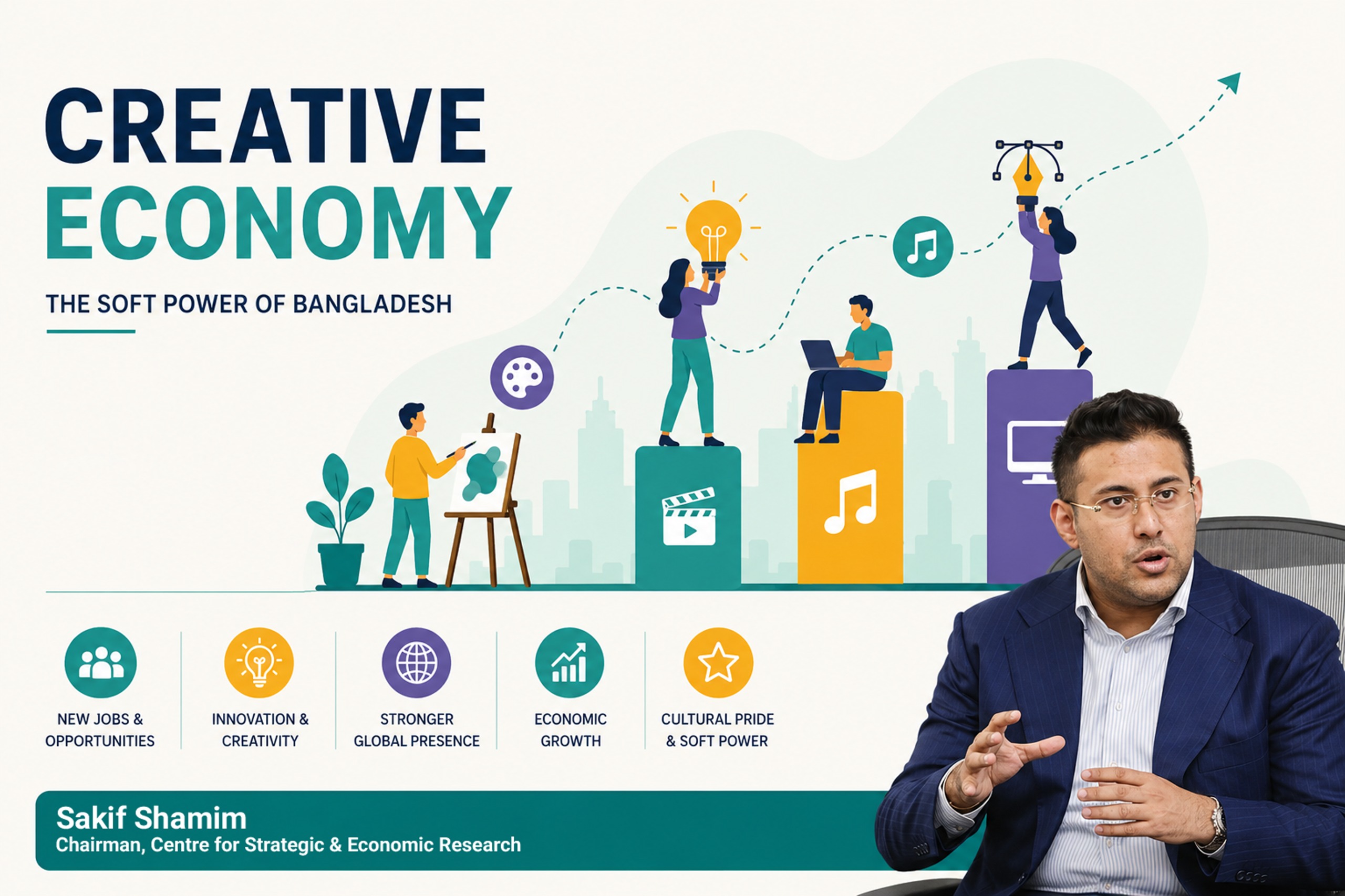

Sakif Shamim
Chairman, Centre for Strategic and Economic Research Managing Director, LabAid Hospital Group
The traditional math of the global economy doesn't apply anymore. For much of the 20th century a country's economic strength was defined by its natural resources, heavy industries and cheap labour. That arithmetic is quietly being revised. The new currency is knowledge, imagination and intellectual property – and it is being spent on film, music, animation, gaming, fashion, design, software, digital content, publishing, advertising, architecture, handicrafts, cultural tourism and now artificial intelligence. These aren’t just cultural pastimes anymore. They together constitute what the world calls the creative economy. A nation that builds it well sees its soft power expanding with its GDP.
Bangladesh is at an unusual crossroad. In a world where life beyond LDC graduation, export diversification and the next wave of jobs are always on the prowl, the creative economy looks like an obvious lever to pull. But in the halls of national policy, it remains an afterthought -- relegated to the "culture" or "entertainment" category, never quite good enough for "economy." The cost of the misfiling is real: an industry that might earn foreign cash, create jobs, develop entrepreneurs, and boost Bangladesh’s name abroad, instead languishes as one of the country’s most underutilized assets.
This has been said by international institutions for years. The creative economy has been identified by UNCTAD, UNESCO and WIPO as one of the fastest expanding parts of the world’s output, because one creative idea, once created, keeps generating income. A movie, a song, a digital game, a piece of software – these are not one-off products, but continuous cash streams, providing the intellectual property behind them is secured. That’s where Bangladesh falls short on protection. CSER is of the view that the country requires a fully digital infrastructure for copyright, licensing and royalty management, where the usage of a creative work is traced automatically and payments dispersed transparently. Build it, and the creative professions become durable economic activity that attracts real investment rather than informal hustles.
The country has no dearth of the raw material for this change. Bangladesh’s rich legacy of literature, music, film, folk culture, Baul heritage along with jamdani, nakshi kantha, shital pati, ceramics and bamboo-and-cane workmanship. Overlaying this heritage is a rapidly developing digital generation – young Bangladeshis who are making their mark in UI/UX design, graphic design, animation, game development, digital marketing, video production, content creation and AI-driven creative services, often on global freelancing platforms. The challenge now is to marry these two currents, legacy and digital, into one economic force rather than let them run as parallel, disconnected stories.
CSER says that this merger should be accelerated and that it should start with the next national budget which should explicitly recognize the creative economy as its own economic sector. From there, a unified Creative Economy Development Fund — across the ministries of industries, ICT, culture, education and commerce — could provide accessible financial and technical support to filmmakers, animators, game studios, designers, musicians, publishers and cultural entrepreneurs. Treat creative industries like conventional sectors, with patient long-term investment, and the pay-off is in jobs, exports and value addition.
Special emphasis should be given to handicrafts and traditional artisanry. Jamdani, nakshi kantha, ceramics, bamboo and cane items, jute-based design, handcrafted jewellery and rural craftsmanship are not merely cultural markers. They are prospective high-value lifestyle exports. Proper branding, GI protection, e-commerce access and export facilitation might generate employment for lakhs of people in this market alone. This is the idea underlying CSER’s planned Creative Export Promotion Programme: dedicated export support, participation in international fairs, access to digital markets and global branding campaigns for GI products, handicrafts, design items, film, music and digital content. This is not a nostalgic side project but a strategic opening in a country seeking to diversify exports beyond clothes.
Music requires its own reckoning. Music has become a mature worldwide industry through streaming platforms, digital licensing, music publishing, live concerts, movies, advertising and international content platforms – everywhere but, totally, in Bangladesh. Bangla melodies, folk music, band culture, and the regional traditions of the country have immense potential, but without a working royalty structure, most artists, lyricists, composers and music directors do not get the long-term rewards that their work deserves. In a well-functioning creative economy, an artist writes a song once and continues to profit from it for years. Bangladesh has to construct that structure, not steal it in name.
The digital design economy tells a similar story of promise ahead of infrastructure. Already there are thousands of young Bangladeshis working in UI/UX design, digital branding, mobile app design, game design and interaction design through international freelance platforms. strengthen skills training, international certification and entrepreneurial support and it may be one of the country’s top high-value service exports.
And there’s a quieter, mostly female-led sector that’s in plain sight: home-based creative businesses. There are many women entrepreneurs running tiny enterprises out of their houses – handicrafts, garment design, handcrafted jewelry, digital art, calligraphy, internet content, baking, home décor, social-media-driven micro-businesses. With the correct training, help in digital marketing, lending and access to international e-commerce platforms, this segment may be a real engine for economic activity in rural areas and for women’s economic empowerment. CSER is of the view that easy loans, venture capital, tax incentives and early-stage business support for creative start-ups, especially in digital content, animation, gaming, design, fashion, film and AI-based creative services, would enable this sector to quickly graduate into a serious export-oriented industry.
There is no frictionless road here. The largest concern is digital piracy – films, music, software, e-books, digital content copied and disseminated illegally, robbing creators and investors of fair rewards and freezing fresh investment. Weak enforcement of copyright, low levels of IP awareness, lack of a functioning royalty collection system, financing constraints, lack of skilled talent, poor international marketing, poor data and fragmented government coordination all play a role, as does the steady drift of talented young people abroad. Bangladesh likewise lacks a credible measurement of the actual contribution of the sector. CSER’s advice here is specific: the Bangladesh Bureau of Statistics should develop a Creative Economy Satellite Account, in line with international norms, to routinely measure the sector’s genuine contribution to GDP, employment, exports and investment. Policy based on speculation rarely survives touch with reality, policy based on data does.
The global playbook is instructive. Success, it seems, is never only about talented people — it is about conscious state policy behind them. India made Bollywood, music, yoga, fashion and internet content a worldwide cultural force, and then connected that force to tourism, investment and service exports. Japan turned anime, manga, gaming and design into one of the world’s most powerful economic brands. South Korea has leveraged K-pop, K-dramas and cinema to extend markets far beyond entertainment, including cosmetics, food, language instruction, tourism and technology industries. The lesson that each of these countries teaches us is the same and important: once culture is integrated into economic policy, it becomes a real engine of national progress.
What Bangladesh today needs is a national creative economy policy which unites culture, education, ICT, commerce, tourism and industrial growth under one umbrella. Firstly, we need to update copyright and IP protection and have effective measures to fight digital piracy. Secondly, a transparent royalties management system needs to be developed for artists, writers, composers, developers and designers so that the creators actually get the proper economic returns for their work.
Third, set up Creative Hubs and Innovation Centres at the divisional level, where entrepreneurs in the fields of animation, gaming, cinema, music, design, fashion and digital media may obtain training, technology, mentorship and investment support. Fourth, universities and technical education should include Creative Entrepreneurship, Design Thinking, IP Management, Digital Media, UI/UX, Creative AI, and Creative Business Management into their curricula—for creativity is economics only when married to entrepreneurial skill. But restricting these measures to divisional cities alone would not bring about the conclusion that the country requires. CSER believes that Creative Clusters should also be developed gradually in promising districts, enabling local artists, artisans, designers, filmmakers, game developers and digital content creators to access shared technology, studio facilities, mentorship, business advice and market connections all on one platform – spreading the benefits of the creative economy nationwide and generating fresh local employment.
Fifth, creative entrepreneurs require dedicated financing, easy credit, venture capital and export help. Sixth, international marketing and branding campaigns for handicrafts, music, cinema, gaming, design and digital content should be launched. Seventh, the Bangladesh Bureau of Statistics should introduce regular measurement of the contribution of the creative economy so that policy making can be based on data rather than assumption.
Bangladesh has already established its reputation in the global labour-intensive economy. Next, the challenge is to evolve towards a knowledge-driven creative economy. If the country can harness its four main strengths – a young population, a rich culture, a tradition of traditional craftsmanship and a growing digital-tech generation – the creative economy will be more than a new export category. This might become one of the pillars of Bangladesh’s international reputation, its soft power and long-term economic prosperity. CSER’s position is clear: ad hoc projects will not sustain this growth; a national long-term roadmap is needed – a roadmap built with 2030 in mind, and that includes clear targets for exports, skills development, IP protection, digital infrastructure, international marketing, research, investment and public-private partnership. A roadmap of this nature would enable the creative economy to be firmly anchored as a fundamental pillar of national industrial policy and export strategy.
The competition in tomorrow’s globe will not be solely in the commodity market. It will be battled out in the marketplace of ideas, culture, design, content and intellectual property.” If the creative economy is to win that struggle, it can no longer be relegated to the edges of cultural discussion in Bangladesh. It must be at the heart of national industrial policy, export strategy, education and economic planning. Because the Bangladesh of the future might not just be known to the world as a place where goods are Made in Bangladesh, but a place where they are Created in Bangladesh.