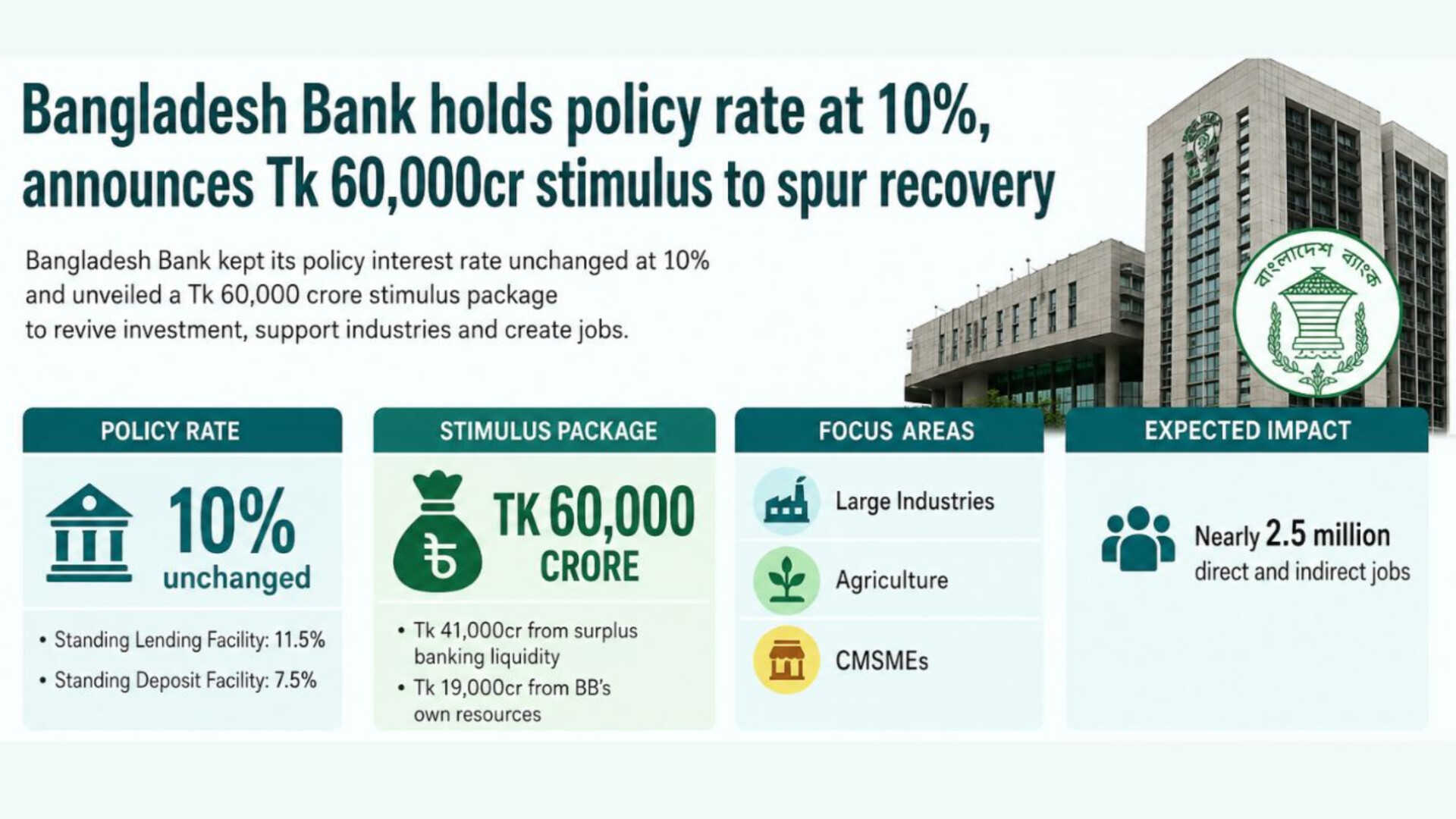

Staff Correspondent: Bangladesh Bank (BB) has kept its benchmark policy rate unchanged at 10 per cent while announcing a Tk 60,000 crore stimulus package to revive private sector investment, support industries and create employment as the economy continues to face high inflation and weak credit growth.
Unveiling the Monetary Policy Statement (MPS) for July–December 2026 on Tuesday, Governor Md Mostaqur Rahman said the central bank would maintain its contractionary monetary policy stance during the first half of FY2026-27 to curb inflation while extending targeted support to productive sectors.
The governor said maintaining low and stable inflation remains the central bank's primary objective to ensure sustainable economic growth, encourage investment, preserve exchange rate stability and facilitate international trade.
According to the policy statement, headline inflation has declined from a peak of 11.7 per cent in July 2024 to 9.4 per cent in May 2026 following prolonged monetary tightening. However, it remains above the government's target of 7.5 per cent for FY2026-27. The government has also set a GDP growth target of 6.5 per cent for the fiscal year.
To maintain monetary discipline, Bangladesh Bank left the policy repo rate unchanged at 10 per cent. The Standing Lending Facility (SLF) rate remains at 11.5 per cent, while the Standing Deposit Facility (SDF) rate has been kept at 7.5 per cent.
At the same time, the central bank announced a Tk 60,000 crore stimulus package to support large industries, agriculture and cottage, micro, small and medium enterprises (CMSMEs). Of the total amount, Tk 41,000 crore will be sourced from surplus liquidity in the banking sector, while the remaining Tk 19,000 crore will come from Bangladesh Bank's own funds.
The central bank expects the programme to generate around 2.5 million direct and indirect jobs while helping industries restore production and improve capacity utilisation.
The policy noted that many manufacturing firms have been operating below capacity due to higher import costs resulting from the depreciation of the taka, rising production expenses and reduced working capital following the COVID-19 pandemic, the Russia-Ukraine war and continuing instability in the Middle East.
Bangladesh Bank also announced regulatory support measures for businesses, including extended repayment facilities for importers facing temporary financial difficulties.
On the financial sector, the central bank pledged stronger efforts to tackle the country's growing non-performing loans (NPLs) through comprehensive audits and a strengthened resolution framework under the newly enacted Bank Resolution Act 2026 and Deposit Protection Act 2026.
It also said implementation of the Expected Credit Loss (ECL) framework under IFRS 9 is being accelerated alongside stronger risk-based supervision. In addition, the proposed Distressed Asset Management Act (DAMA) is being finalised to enable banks to transfer bad loans without relying on taxpayers' funds.
Bangladesh Bank further plans to amend the Money Loan Courts Act to expedite loan recovery and asset disposal.
As part of its digital financial agenda, the central bank highlighted the rollout of Bangla QR, an interoperable payment platform designed to facilitate seamless transactions across commercial banks and mobile financial service providers.
Looking ahead, Bangladesh Bank expects economic growth and private investment to recover gradually with support from the FY2026-27 budget and targeted credit programmes. However, it warned that inflationary pressures, energy shortages, banking sector vulnerabilities, external imbalances and global geopolitical uncertainties continue to pose significant risks.
Governor Mostaqur Rahman said the central bank would continue to pursue prudent monetary policies to safeguard macroeconomic stability while creating the conditions for stronger, sustainable and inclusive economic growth.