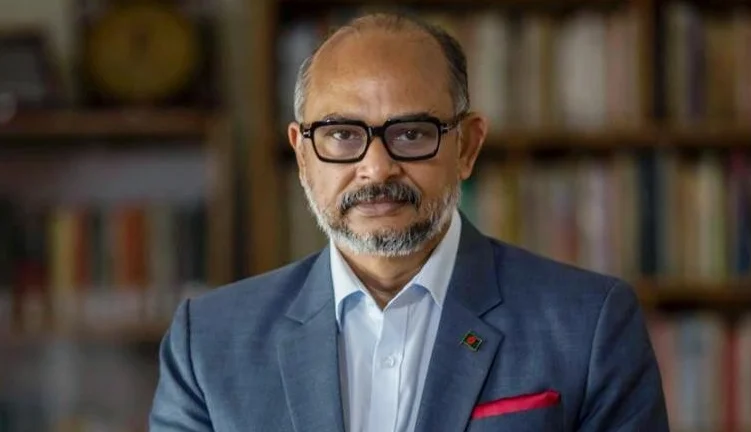


Power, Energy and Mineral Resources Minister Iqbal Hassan Mahmood today said that the government is considering introducing a five-year tax holiday and reducing import duties to nominal levels to encourage greater private sector investment in the solar power sector.
“An investment-friendly policy framework for the solar energy sector is expected to be finalized and announced by June,” he said.
The minister made the remarks while speaking as the chief guest at the inaugural session of a market sounding workshop on “130-140 MW (AC) Grid-Tied Solar Power Plus Battery Storage Project” at the Bangladesh Investment Development Authority (BIDA) headquarters in the city.
Bangladesh Economic Zones Authority (BEZA) organised the workshop to establish a solar power plant under Public-Private Partnership (PPP) method at the National Special Economic Zone (NSEZ) in Mirsarai, Chattogram,
In his speech, the minister said that the government is evaluating reductions in import duties and taxes on key solar equipment, including solar frames, photovoltaic cells and batteries.
“As a businessman, I understand which facilities are required to attract investors,” he said adding that the government is prioritizing expansion of the investment base over immediate revenue collection.
He said the proposed five-year tax holiday and reduced import duties are aimed at encouraging entrepreneurs to invest in the sector, after which the government would begin receiving tax revenues from a mature industry.
Drawing a comparison with the ready-made garment sector, the minister noted that the sector’s growth accelerated after the introduction of bonded warehouse and back-to-back letter of credit facilities in 1979.
He said the government now intends to introduce similar high-impact policy support for the solar sector.
Highlighting the potential for urban solar generation, the minister said nearly 1,000 megawatts of electricity could be produced by utilizing rooftops in the Dhanmondi and Mohammadpur areas of Dhaka alone.
Under the proposed model, private investors would be allowed to use rooftops for solar power generation through net metering systems, enabling them to earn revenue while easing pressure on the national power grid, he added.
He said the saved electricity could then be redirected to industrial factories to support production and economic growth.
As the special guest, State Minister for Power, Energy and Mineral Resources Aninda Islam Amit said that Bangladesh’s renewable energy transition would require private sector investment, technology, implementation capacity and operational expertise.
He said that the Renewable Energy Policy 2025 and the newly developed Renewable Energy PPP Guidelines 2026 provide a practical framework to move forward.
The guidelines are particularly important because they address one of the most difficult challenges in solar development — access to suitable land, he added.
“By using appropriate government-owned land under a PPP framework, we can reduce development risk, improve project preparation, and attract more serious private sector participation,” he said.
He mentioned that the Sonagazi project is an important test case.
“It is located at the National Special Economic Zone, where BEZA-owned land can be used for clean energy generation. The proposed project structure brings together the key institutions: Bangladesh Economic Zones Authority as land owner and project sponsor, Bangladesh Power Development Board as offtaker, Power Grid Company of Bangladesh for grid evacuation, Power Division for policy support, Sustainable and Renewable Energy Development Authority for renewable energy policy coordination, and PPPA for PPP structuring and procurement support,” he added.
He said the project is also forward-looking because of the potential inclusion of battery energy storage.
“As Bangladesh increases the share of solar and other variable renewable energy, storage will gradually become more important for grid stability, peak management, and better utilization of renewable power. This is why it is useful to discuss BESS at this early stage and understand how the market views its commercial and technical integration,” he added.
He said, “I would also like to emphasize that the government is not here today only to present a project. We are here to listen.”
He noted that the purpose of market sounding is to understand investor expectations, lender requirements, risk perception, and practical suggestions before finalizing the structure and tender documents.
“The feedback received today can help improve the project’s bankability and make the bidding process more competitive,” he said.
He mentioned that the private sector has an important role to play in Bangladesh’s renewable energy journey.
“We need your capital, technology, execution capacity, and operational experience. At the same time, the government must create the right enabling environment through clear policies, bankable documents, predictable processes, and proper coordination among agencies,” he said.
He thanked BEZA and PPPA for taking leadership on the pilot initiative, and the Asian Development Bank for supporting the government with transaction advisory services.
He hoped that the consultation would generate practical feedback to help the government launch a credible, competitive and bankable tender.
“If this project succeeds, it can open the door for many more renewable energy PPP projects in Bangladesh,” he added.
At the workshop, Executive Chairman of BEZA Chowdhury Ashik Mahmud Bin Harun said the Sonagazi project carries strategic importance for three reasons.
He said the project uses government-owned land, helping address land scarcity, one of the major obstacles for private investment in solar energy.
He added that the project also includes the country’s first Battery Energy Storage System, which will help supply electricity during peak demand hours and improve grid synchronization.
According to him, the project is also intended to serve as a model for future private investments on unused government land.
Ashik Chowdhury stressed the need for a structural shift in the management of the power sector, saying the government should move from being an investor to acting as a facilitator for private sector investment.