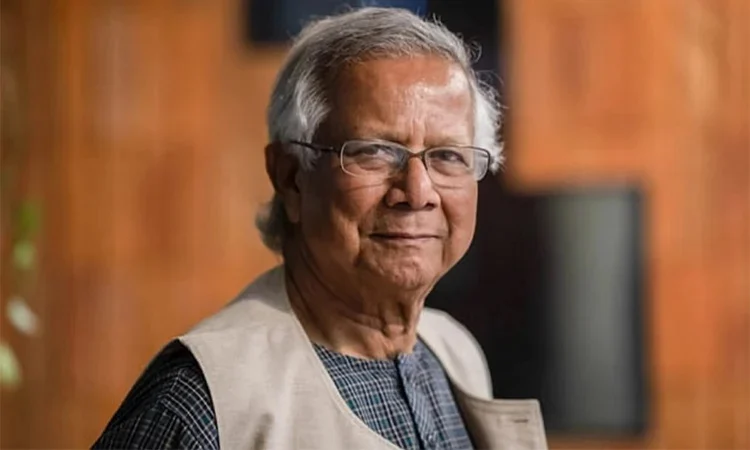

Chief Adviser Professor Muhammad Yunus today said the country would undergo a fundamental transformation and misgovernance would not return if the "Yes" vote prevails in the referendum slated for February 12.
"If the 'Yes' vote wins in the referendum, Bangladesh's future will be built in a more positive way," he said.
The Chief Adviser told senior secretaries and secretaries at his office in Tejgaon. The Cabinet Secretary presided over the meeting.
Later in the afternoon, Chief Adviser's Press Secretary Shafiqul Alam briefed the media on the discussion at the Foreign Service Academy.
Expressing strong confidence in the upcoming national election, Professor Yunus said it would be free, fair, peaceful and festive.
Referring to past elections, he said previous polls could hardly be described as genuine elections, calling them "mock exercises" and "fake elections."
"In contrast, the forthcoming election will be held in a free, fair and peaceful manner. With only two days remaining, the country is almost at its destination," he said.
The Chief Adviser said the election, along with the referendum, would bring an unprecedented change to Bangladesh's political structure.
Highlighting a major first, he said expatriate Bangladeshis have been formally included in the political process, acknowledging their past role in political movements and uprisings and enabling them to play a stronger and more meaningful role in national affairs in the future.
Professor Yunus also called for the extensive use of technology in the election, saying it has made the process easier and more accessible. He said a mobile app has been developed to guide voters on casting their ballots, while election-related apps are being used to monitor security at nearly 43,000 polling centres across the country.
The "Election Bondhu", he said, initiative has been introduced, body-worn cameras have been provided to around 25,700 law enforcement personnel, and CCTV cameras are being installed at polling centres.
Expressing optimism, the Chief Adviser said the election would be better than any held previously in the country.
The Chief Adviser said the arrival of a large number of international observers from different countries reflected renewed global confidence in Bangladesh's democracy and showed that the international community was taking the election seriously.
Professor Yunus observed that the previous three elections held under the former Sheikh Hasina government lacked legitimacy and did not see the presence of credible international observers.
He also said there has so far been no significant tension surrounding the election.
"Campaigning is taking place peacefully across the country. Political parties are playing a responsible role and large public gatherings are being held without violence or disorder," he added.
The Chief Adviser thanked the secretaries for their performance over the past 18 months, particularly for their cooperation in expediting work related to around 130 ordinances issued during this period, saying their support and efficiency had been critical to the government's work.
Looking ahead, Professor Yunus said Bangladesh would continue to move forward and attract global investors to establish factories in the country, describing the nation's young population as a vast and powerful resource.
Referring to the Japan-Bangladesh Economic Partnership Agreement (EPA), he said duty-free and preferential market access through investment in Bangladesh would encourage many foreign companies to set up production facilities in the country.
He reiterated that the Japan-Bangladesh EPA is the first of its kind and should serve as a model, adding that Bangladesh will pursue more free trade and preferential trade agreements.
Such agreements, he said, would open new doors for the economy and expand opportunities for Bangladeshi products.
Later, the Chief Adviser posed for photographs with senior secretaries and secretaries of the government.