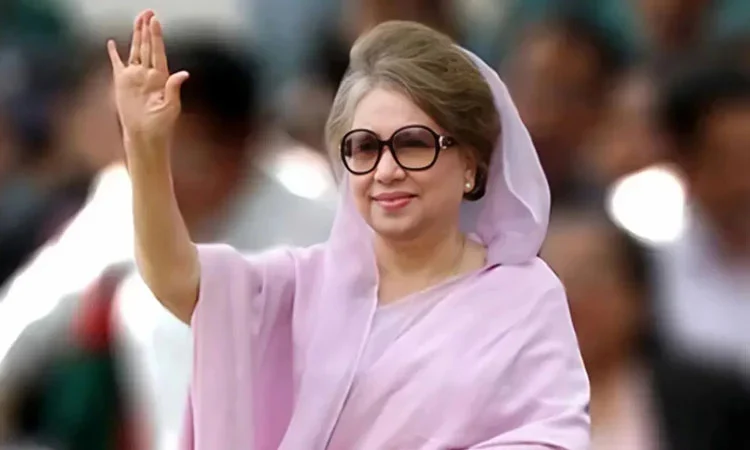

BNP Chairperson Begum Khaleda Zia, widely regarded as an uncompromising leader for democracy in Bangladesh, had been the party chairperson until her death today since 1984. She was the first woman to be elected as the prime minister of Bangladesh, and the second in the Muslim world.
The three-time Prime Minister Begum Khaleda Zia was born to Iskandar Majumder and Taiyaba Majumder in Dinajpur district on August 15, 1945 though her family originally hails from southeastern Feni. She studied at Dinajpur Government Girls High School and later at Surendranath College.
In 1960, she was married to Ziaur Rahman, a military captain at that time who later became a Liberation War hero and proclaimed independence and subsequently became the President of Bangladesh.
Begum Zia accompanied him as the First Lady while meeting many world leaders, including Prime Minister Margaret Thatcher of the UK and Queen Juliana of the Netherlands.
Following the martyrdom of President Zia in the abortive coup of 1981, she joined BNP as a general member on 2 January 1982 and in March next year elected as its vice-chairman while the party elected as its Chairperson, a position which she held until her death.
A year after Ziaur Rahman's death a military coup in 1982, by led by then army chief General Hussain Muhammad Ershad toppled the BNP government when Begum Zia emerged in the public domain with greater prominence.
She initiated an all-out movement for restoring democracy. She was the architect of forming a seven-party alliance in 1983 to put an end to Ershad's dictatorship. She refused to take part in the subsequent 1996 elections and denounced the rigged polls.
The rivals Awami League, Jamaat-e-Islami and Communist Party of Bangladesh (CPB) joined the election under Jatiya Party-led rule purportedly to endorse the illegitimate government.
But Begum Zia's firm stance for democracy prompted the then Ershad regime to detain her seven times in from 1983 to 1990, when a mass upsurge toppled it.
She led the mobilization of BNP's student front, Jatiyatabadi Chatra Dal (JCD) and they won 270 of 321 student unions across the country. These students were instrumental in the movement that led to the fall of Ershad's regime.
Begum Zia's staunch opposition against the military rule and dictatorship and commitment to restoring democracy earned her the repute of being "the uncompromising leader" in the 1980s.
The February 27, 1991 elections, nationally and internationally hailed as free, fair and credible polls, brought her BNP to power and she became the country's first woman prime minister.
During her premiership, Bangladesh switched to parliamentary democracy from the presidential form of government while the 1991-1996 era of her government carried out some major economic transformations. The employment rate increased rapidly and in the readymade garments (RMG) sector alone, the employment growth was 29 percent in five years. Almost two hundred thousand women joined the RMG industry thanks to her policies.
On the global front, she raised the Ganges water-sharing problem in the United Nations to mount pressure on upstream India to allow Bangladesh to have a fair share of water from the common river.
Her first term as the premier saw an influx of Rohingyas but her government managed to influence the international arena to mount a pressure on Myanmar, which eventually entered into a deal with Bangladesh to repatriate Rohingya Muslim refugees. She was invited to the White House in 1992 where she prominently raised the Rohingya issue.
Begum Zia became the premier again after the February 1996 elections within a month she handed over power to a caretaker government to oversee a fresh election in June the same year when BNP lost but retained 116 out of 300 constituencies to become the largest opposition in Bangladesh's parliamentary history.
Aiming to return to power, the BNP formed a four-party opposition alliance in 1999 with the Jamaat-e-Islami, a faction of the Jatiya Party (Naziur), and the Islami Oikya Jote and launched a staggered campaign against the ruling Awami League.
Begum Zia was re-elected as the Prime minister in 2001 as her party regained power by promising to eliminate corruption and terrorism. Forbes magazine ranked her at number 29 in 2005 in its list of the hundred most powerful women in the world for her role in promoting women's education and empowerment of women.
In 2006, on completion of her five-year tenure as the head of the four-party alliance government, she handed over power to a caretaker administration as per the constitution.
On 11 January, 2007 a military-backed extraordinary type of government took over. After failing to send Begum Zia abroad as part of a seemingly de-politicization plan, they arrested her in September, 2007 on trumped-up and baseless charges of corruption.
Her two sons - Tarique Rahman and Arafat Rahman - too were arrested, tortured and banished from the country. She had to bear with tremendous shock as her younger son Arafat Rahman died in exile in Malaysia in 2015.
Begum Zia's in their full two terms made considerable progress in the education sector by improving compulsory free primary education, introducing free education for girls up to 10th grade, an education "stipend" for girl students, and food for education programs.
Her government also increased the age limit for entry into government services from 27 years to 30 years and made its highest budgetary allocation to the education sector.
Begum Zia held a unique record of never losing in any election from any constituency. She was elected in five separate parliamentary constituencies in the general elections of 1991, 1996 and 2001. In 2008, she won in all three constituencies from where she contested.
Since 2009, when the Sheikh Hasina-led government turned Bangladesh into an authoritarian state, Begum Zia renewed her fight for democracy. She was forcefully expelled from her house by the government and was put under house arrest twice when she launched movements for democracy. For her commitment to democracy, she was honoured as "Fighter for Democracy" by New Jersey's State Senate in 2011.
Begum Zia was sentenced to 17 years in prison in 2018 in two graft cases over the Zia Orphanage Trust and Zia Charitable Trust for alleged corruption. In its 2020 Country Reports on Human Rights Practices, the United States State Department stated, citing international and domestic legal experts, that the "lack of evidence to support the conviction" shows the prosecution was a political ploy to remove her from the electoral process. Amnesty International expressed worry that her "fair trial rights are not being respected."
The higher court, however, acquitted her in one case on November 27, 2024 and in another case on 15 January 2025. But her health condition became very fragile during her jailed life.
Despite serious illness, the autocratic regime did not allow her to take treatment overseas.