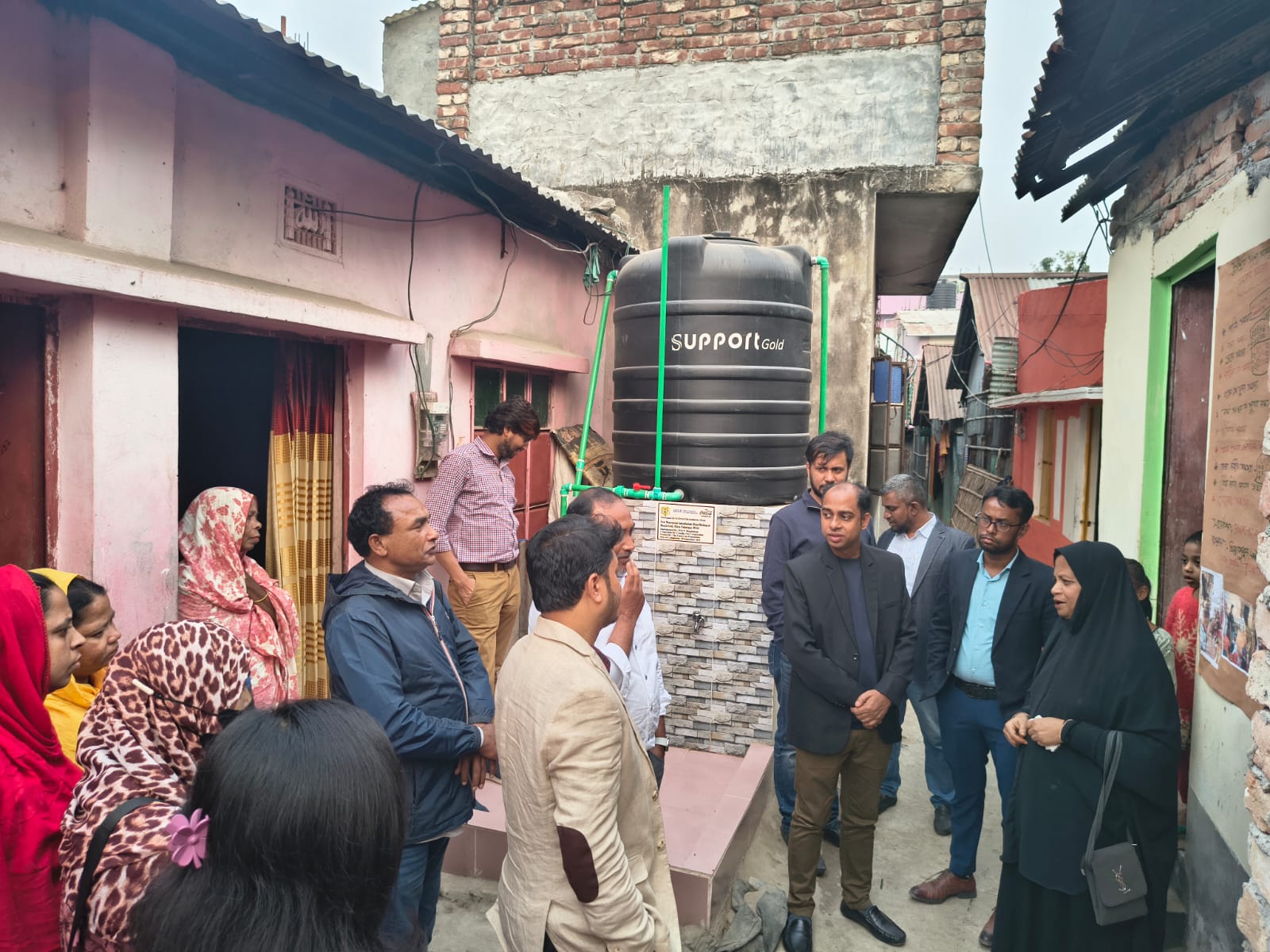

There was a time when Majeda Begum had to leave home before dawn to collect water. She lives in the Dishabandh area along Paduar Bazar Road in Comilla city. Only after bringing water from a tube well nearly two kilometers away could she begin her household chores. Carrying water over such a long distance was a daily struggle. Recalling those days, she says, “We had to bathe, wash clothes—do everything—with dirty pond water. Now I get clean water right next to my home. Life has completely changed.”
A visit to the area shows that Majeda Begum is not alone. Similar stories of change are emerging in several low-income neighborhoods under the Comilla City Corporation. Leaving behind their dependence on open ponds, residents are now gaining continuous access to safe water. This transformation has come through the Resilient Water and Sanitation Programming for Low-Income Communities project, implemented with support from Water and Sanitation for the Urban Poor (WSUP) and The Coca-Cola Foundation.
According to project data, previously only 11 percent of households in these areas received water at fixed times. Now, 77 percent of families have access to safe water around the clock. Overall access to safe water has increased to 52 percent. As a result, dependence on pond water or private water vendors has declined significantly. Families that once had to spend between BDT 400 and 1,000 per month on purchased water are now getting safe water for as little as BDT 30.
In areas like Thirapukurpar, similar to Dishabandh, access to water points has transformed the lives of low-income residents—especially women and children. Nurjahan Begum Dolly, a resident and community leader of Thirapukurpar, says, “Earlier, girls were regularly harassed while going to collect water. Out of fear, many of them stopped going altogether. Now, with water points nearby, that fear no longer exists.”
According to local estimates, women are now saving at least one to two hours every day on water collection. They are using this time for income-generating activities or to care for their families.
Health risks have also decreased significantly. In the project areas, the incidence of waterborne diseases has dropped from 42 percent to below 2 percent. This has reduced medical expenses and improved children’s health. Teachers also report that student absenteeism has declined since schools began receiving safe drinking water.
The initiative goes beyond infrastructure alone. A total of 216 water points have been installed or rehabilitated in Comilla and Chattogram, benefiting more than 25,000 people. At the same time, over 1,200 local residents—many of them women—have been trained in water management and basic maintenance. As a result, communities are now maintaining the water points themselves.
WSUP Bangladesh Country Manager Uttam Kumar Saha says, “These water points are not just sources of water; they are foundations of social change. Women’s safety has improved, and health risks have declined.” Mohammad Yusuf, Assistant Engineer of Comilla City Corporation, believes that although citywide piped water supply is not yet feasible, this model represents a successful and sustainable solution.
Beyond low-income neighborhoods, WSUP and TCCF have also ensured safe water access in several schools in Comilla city. Through RO filters, these schools are now supplied with drinking water.
Uttam Saha adds, “We have learned from school headteachers that the availability of clean, safe, and iron-free drinking water has reduced parents’ concerns and lowered student absenteeism. To ensure that these facilities benefit communities in the long term, we have trained local residents in every project area so they can maintain and care for the water points themselves. We believe this Comilla model can be successfully replicated in other cities across the country.”
Safe water and a harassment-free environment—together, these two factors are transforming lives in Comilla’s low-income communities. The journey from murky pond water to nearby safe supply is opening new possibilities for the city’s marginalized residents.