

Staff Correspondent: Bangladesh needs urgent, coordinated action to tackle a growing energy crisis that is no longer simply a short-term supply problem but a deeper structural challenge, the Centre for Policy Dialogue (CPD) has said.
The policy research organisation has called for immediate, medium- and long-term measures, including more efficient LNG procurement, faster domestic gas exploration and a major expansion of renewable energy.
The recommendations came at a discussion titled “Tackling Bangladesh’s Energy Crisis: Immediate Priorities and a Roadmap for a Sustainable Energy Future” in Dhaka on Thursday.
CPD Senior Research Associate Fakhruddin Al Kabir presented the keynote paper at the event, attended as chief guest by Power, Energy and Mineral Resources Minister Iqbal Hasan Mahmud.
LNG dependence under pressure
The CPD said Bangladesh’s growing reliance on imported LNG was making the energy system increasingly vulnerable to international price volatility, while domestic gas production continued to decline.
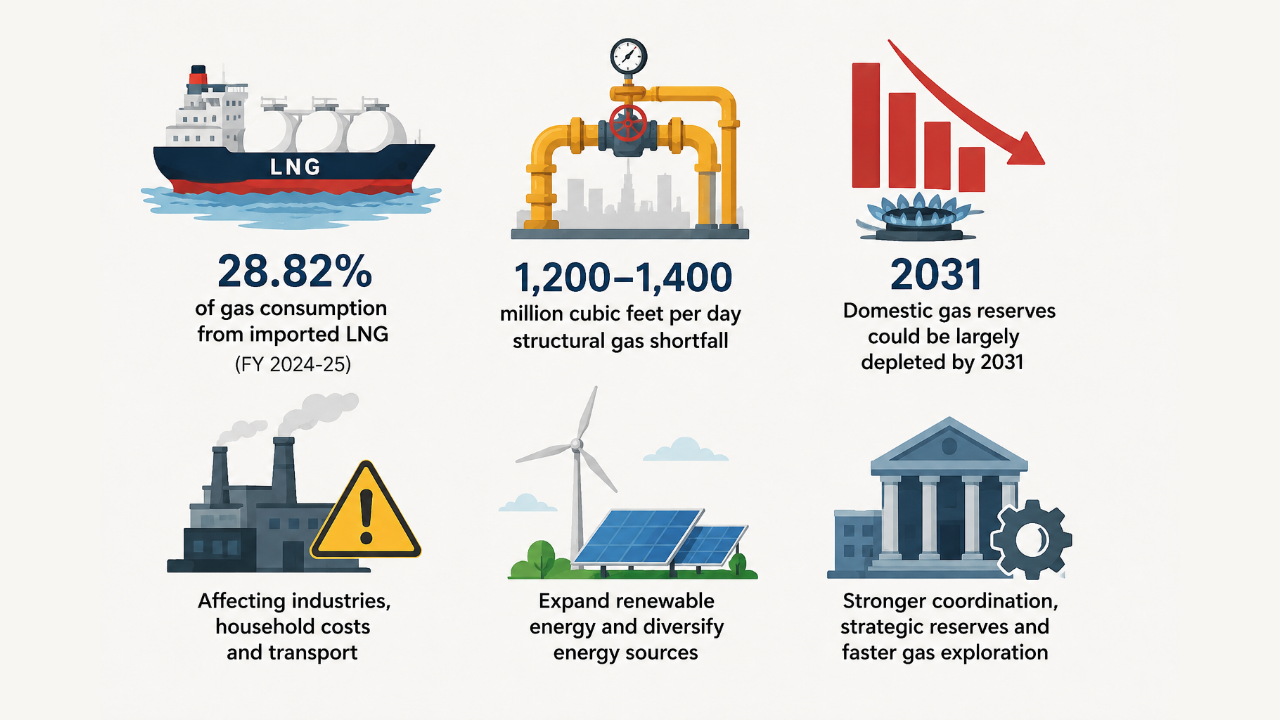
Imported LNG accounted for 28.82% of the country’s total gas consumption in fiscal 2024-25, according to the paper.
Bangladesh currently faces a structural gas shortfall of around 1,200–1,400 million cubic feet per day, it said.
The organisation warned that if gas consumption continues at the current rate, the country’s remaining domestic gas reserves could be largely depleted by 2031.
The warning comes as industries are already feeling the strain. The CPD said the gas shortage was affecting industrial production, household energy costs and transport, with sectors including readymade garments and fertiliser manufacturing facing production cuts or temporary shutdowns.
What CPD wants now
As immediate measures, the CPD recommended improving LNG procurement to reduce exposure to international price swings, introducing appropriate pricing mechanisms to encourage efficient energy use and reforming regulatory institutions.
It also called for expanding social protection for vulnerable groups and reviewing existing policies governing private investment in the energy sector.
Over the medium term, the CPD recommended expanding LNG terminals and storage facilities, strengthening transmission and distribution networks through targeted investment, and adopting time-bound policies to diversify energy sources.
It also urged the government to create a more effective policy framework for expanding renewable energy.
Gas exploration as a national priority
Looking further ahead, the CPD called for stronger institutional coordination among ministries and agencies, strategic energy reserves to prepare for future supply disruptions and faster domestic gas exploration as a national emergency priority.
The paper argued that Bangladesh cannot secure long-term energy security without expanding domestic gas exploration, increasing renewable energy use, upgrading transmission and distribution infrastructure and reducing dependence on imported fossil fuels.
The country’s electricity generation capacity remains heavily dependent on fossil fuels, with more than 84% relying on natural gas, coal and furnace oil, while renewable energy and hydropower still make only a limited contribution.
The CPD said the present crisis was rooted in several long-standing weaknesses, including inadequate exploration, infrastructure constraints, a widening mismatch between demand and supply, and growing dependence on imported LNG.
Energy experts, business leaders, academics and representatives from different sectors attended the discussion, underscoring the growing concern over an energy problem that is increasingly being felt not only in power plants, but also on factory floors and in household budgets.