
Niaz Mahmud
Finance Minister Amir Khosru Mahmud Chowdhury placed the proposed national budget for the fiscal year 2026–27 in the 13th Jatiya Sangsad on Thursday, marking the first budget of the newly elected BNP-led government.
The budget was presented amid significant economic challenges, including persistent inflation, pressure on foreign exchange reserves, rising public debt, and the need to accelerate investment and employment generation.
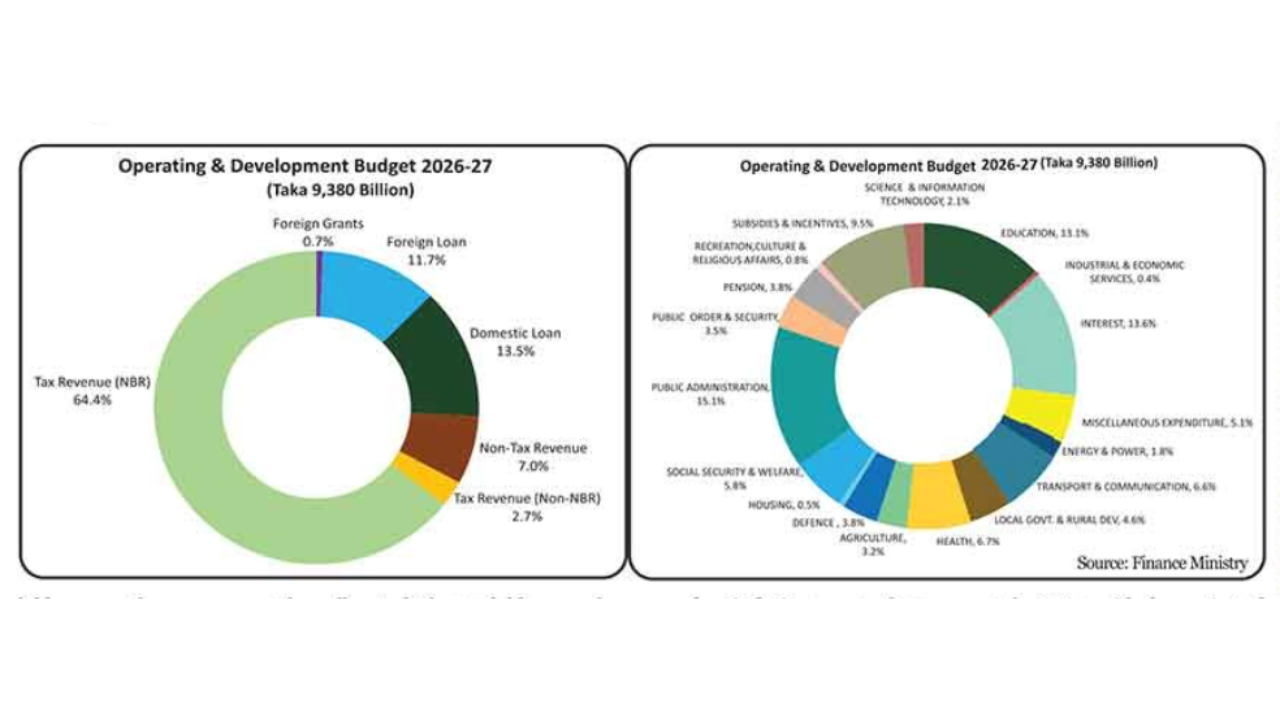
The proposed budget, estimated at more than Tk 9.38 lakh crore, is the largest in Bangladesh’s history. The government has described it as a people-oriented and growth-focused budget aimed at restoring macroeconomic stability while promoting inclusive development and strengthening fiscal discipline.
The government has set an overall revenue mobilisation target of Tk 6.95 lakh crore to finance the expenditure programme. Of the total revenue target, the National Board of Revenue (NBR) is expected to collect Tk 6.04 lakh crore. Another Tk 25,000 crore is projected to come from non-NBR tax sources, while non-tax revenue receipts are estimated at Tk 66,000 crore.
A significant portion of the budget will be spent on debt servicing. The proposed budget projects an overall deficit of Tk 2.43 lakh crore.
The government has allocated Tk 1.27 lakh crore for interest payments, including Tk 1.05 lakh crore for domestic debt and Tk 22,500 crore for foreign loans.
To finance the deficit, the government plans to borrow Tk 1.09 lakh crore from external sources and Tk 1.12 lakh crore from the banking system. The remaining Tk 15,000 crore is expected to be mobilised through national savings certificates.
The government has set a GDP growth target of 6.5 per cent and an inflation target of 7.5 per cent for FY27, with the projected size of the economy estimated at Tk 68.30 lakh crore.
In his budget speech, the finance minister highlighted the government's priorities in education, healthcare, employment generation, private-sector-led investment and social protection. He reiterated the government's pledge to build a knowledge-based economy and expand opportunities for the country's growing youth population.
Presenting the budget in Parliament, the finance minister emphasised that the government’s primary objective is to stimulate economic growth, create jobs, control inflation, and improve public services. He said the budget has been formulated in a challenging global and domestic economic environment and seeks to balance development spending with prudent fiscal management.