
Staff Correspondent: Bangladesh has increased electricity tariffs at wholesale, retail and transmission levels, imposing a fresh financial burden on households and businesses already grappling with rising living costs.
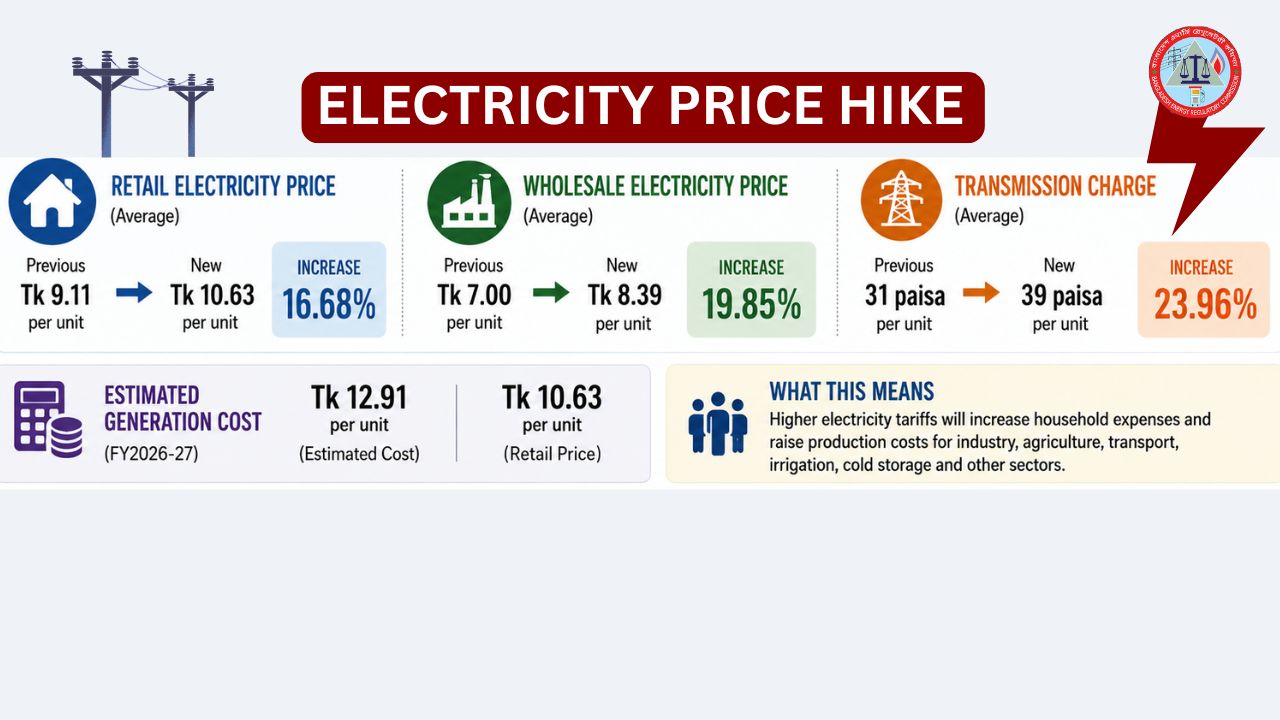
The Bangladesh Energy Regulatory Commission (BERC) on Wednesday announced a 16.68 per cent increase in retail electricity prices, a 19.85 per cent rise in wholesale tariffs and a 23.96 per cent increase in transmission charges. The new rates will take effect from electricity bills for June.
Under the revised tariff structure, the weighted average retail electricity price has been raised from Tk 9.11 to Tk 10.63 per unit. At the wholesale level, the average tariff has increased from Tk 7.00 to Tk 8.39 per unit.
BERC Chairman Jalal Ahmed announced the new prices at a press briefing at the commission's headquarters in Dhaka.
According to the regulator, electricity tariffs for different consumer categories have been increased by between 15 per cent and 19.94 per cent. Demand charges for consumers, however, remain unchanged.
Responding to questions over the speed of the decision, Ahmed said there had been no external pressure on the commission and that the tariff adjustment was completed quickly in consideration of the national budget process. "There was no pressure. We wanted to complete the process before the budget," he said. He acknowledged that the higher tariffs would increase consumer expenses but said no formal assessment had been carried out on the wider economic impact of the price hike. "There is an opportunity to conduct such an assessment," he added.
The latest increase comes just days after fuel prices were also adjusted upward, raising concerns about the cumulative impact on inflation and business costs.
Industry experts warn that higher electricity tariffs could increase production costs across a wide range of sectors, including manufacturing, agriculture, irrigation, transport and cold storage. Businesses may eventually pass on those additional costs to consumers, adding further pressure to food and commodity prices.
The decision follows public hearings held by BERC on May 20 and 21, where proposals from power sector entities were reviewed.
The state-owned Bangladesh Power Development Board (BPDB) had sought an increase of between Tk 1.20 and Tk 1.50 per unit in wholesale electricity prices, equivalent to roughly 17-21 per cent. In its submission, BPDB estimated that electricity generation costs in fiscal year 2026-27 would reach nearly Tk 143,108 crore, with the average cost of generating electricity rising to around Tk 12.91 per unit.
Under the current power sector structure, BPDB purchases electricity from public and private power plants under contractual arrangements and sells it to six distribution utilities at government-approved wholesale rates. The gap between purchase and sale prices is largely covered through government subsidies, while distribution companies do not receive direct subsidies and rely on retail sales to meet their operating costs.
Separately, Power Grid Bangladesh PLC (PGCB), the country's sole electricity transmission company, had proposed increasing wheeling charges from around 30-31 paisa per unit to 48-49 paisa per unit. BERC eventually approved an increase in average transmission charges from 31 paisa to nearly 39 paisa per unit.
Before Wednesday's decision, the last electricity tariff adjustment took place on February 29, 2024, when the government raised retail electricity prices by 8.5 per cent through an executive order. Wholesale tariffs were also increased by around 5 per cent at that time.
The latest increase is expected to generate debate over the balance between ensuring financial sustainability in the power sector and protecting consumers from rising living costs at a time of persistent economic pressures.