
A nationwide civic pulse check finds older, rural, and low-education voters are most likely to be under-informed about the referendum and July Charter, while voters worry about disruption and result acceptance remain high.
Bangladesh is entering a decisive electoral moment shaped by the July movement and it’s taking place alongside a referendum, widening the stakes beyond party competition to include institutional reform choices, voter inclusion, and the credibility of outcomes. A new national public perception survey suggests that many citizens want to participate, but are doing so with significant knowledge gaps and a persistent sense of uncertainty about what happens after results are declared.
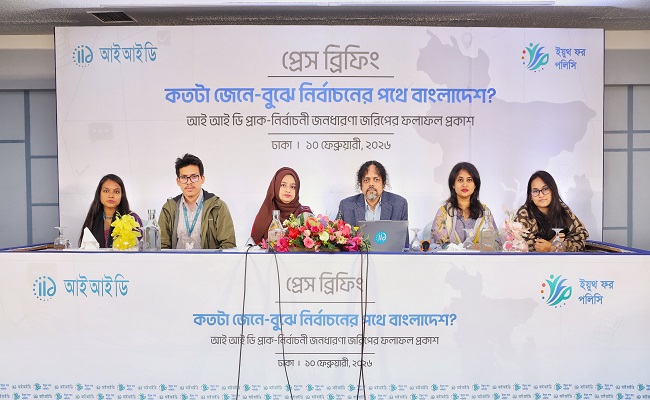
The survey was conducted by the Institute of Informatics and Development (IID) and its youth platform Youth for Policy (YfP) as a non-partisan “pulse check” on whether people feel informed enough to make choices, included and safe enough to participate, and confident enough in democratic fairness to accept outcomes. Data were collected on 6–7 February 2026 from 9,892 eligible voters across all eight divisions through a stratified coverage plan.
The referendum: One YES/NO choice that covers multiple confusing reform themes
The referendum ballot asks voters to mark only one box—YES or NO—yet the question bundles several reform themes and links them to the July Charter and commission/reform proposals. In practical terms, a single YES/NO is being asked to cover multiple commitments at once. The survey indicates a predictable risk: many voters have limited exposure to the referenced documents and therefore do not feel confident about what a YES or NO would mean in practice.
Informed: Knowledge gaps are large, and they hit older, rural, and low-education voters hardest
Only 37.2% nationally say they know what is in the July Charter. This topline hides deep inequality. Among voters aged 35+, only 23.2% say they know, compared with 45.7% among voters aged 18–35. Rural respondents are also less likely to say they know (32.4%) than urban respondents (41.4%). Among respondents with no formal education, just 8.4% say they know what is in the Charter, while 77.2% say “no” or “don’t know.”
Awareness is weak even on specific reform content. For example, only 43.1% say they know what changes are proposed on fundamental rights, while low awareness (no + don’t know) is 55.3% nationally and rises sharply among older and low-education respondents.
The clearest pre-election inclusion risk emerges when knowledge is tested at the ballot level. Nationally, 72.4% say they can easily read and understand the referendum ballot text. Among voters aged 35+, that falls to 57.4%. Among voters with no formal education, it falls to 26.6%. In other words, the people most vulnerable to exclusion are least confident about reading and understanding the referendum ballot.
Many citizens also report that they do not know what would happen if “yes” or “no” wins. For “yes wins,” low awareness is 29.6% nationally, rising to 42.7% among voters aged 35+ and 62.2% among voters with no formal education. For “no wins,” low awareness is 33.6% nationally and rises to 47.8% among 35+ and 67.5% among no-education voters. Rural respondents are consistently less likely than urban respondents to say they understand these consequences.
Inclusive: Many do not know their preferred party’s stance, and civic space is not equal
When asked whether their preferred political party has signed the July Charter, only 43.0% say “yes.” A large share says “don’t know” (37.4%), and another 12.5% prefer not to answer. Uncertainty is highest among voters aged 35+ (48.3% “don’t know”), rural respondents (41.7% “don’t know”), and voters with no formal education (63.4% “don’t know”). This suggests many citizens are being asked to decide on reforms without clear knowledge of where their own preferred side stands.
Inclusion also depends on civic space. While 63.0% say they can speak openly about elections, 20.2% say they cannot. The Adibasi/ethnic subgroup reports particularly constrained openness (46.7% say they cannot speak openly). The pattern remains a warning sign that fear and self-censorship are not evenly distributed.
Anxious: Fear of disruption is widespread, and result acceptance remains uncertain
A majority of respondents (55.0%) say election-day problems or insecurity could prevent people from voting. This matters because perceived risk can suppress turnout and amplify rumours, especially where information is already limited.
On post-poll stability, the survey’s most strategic warning concerns result acceptance. Only 51.0% believe losing sides will accept election results fully or partially. Meanwhile, 35.8% are uncertain or unwilling to answer, with uncertainty particularly high among women and among voters with no formal education. In a transition period, this “uncertainty zone” can become fertile ground for competing narratives and contested legitimacy after results are declared.
Public perception of government neutrality during election is marked by uncertainty: 47.9% of respondents say the government is neutral on voting, 11.3% say it is not, while 33.7% say they “don’t know” if the government is neutral (rising to 39.7% among women), and 7.1% prefer not to answer.
Hope: Most still expect to vote safely, and inclusion aspirations remain strong
Alongside anxieties, the survey records clear participation hope. A combined 86.4% say they feel safe going to the polling station (64.0% “yes” + 22.4% “somewhat”). A combined 82.5% expect religious or ethnic minorities can vote without fear in their area (69.7% “yes” + 12.8% “somewhat”).
On women’s voting agency, 68.0% say women vote by their own judgement. At the same time, 21.1% believe women vote according to a husband’s or father’s preference, indicating that household influence remains important in many communities even where women’s participation is recognized.
What this means
A reform mandate without public understanding risks undermining the July Movement’s promise
The July Movement put anti-discrimination and reform at the centre of public expectations, yet the survey indicates the election–referendum is unfolding with significant information inequality. Knowledge gaps are widest among voters aged 35+, rural communities, and people with little or no formal education, including limited understanding of what the July Charter contains and what a “yes” or “no” outcome would mean. This suggests the interim period prioritised closed-door reform bargaining over public engagement at the scale required for an informed, inclusive referendum. The next government should treat this as a legitimacy issue and launch a time-bound, non-partisan public information effort in plain language, prioritising the least-informed groups.
The bundled ballot design creates ambiguity that can fuel post-election conflict
Field commentary highlights a plausible confusion: the referendum package includes an upper-house proposal, while another clause links implementation to political parties’ commitments—raising questions about what prevails if a winning party opposes the upper house. When multiple reforms are bundled into one yes/no vote, internal tensions can become post-poll dispute triggers. Clear, authoritative pre-election guidance on how provisions interact would reduce interpretive conflict.
If time is insufficient for a fully informed referendum, the minimum standard must be an inclusive and safe election
With limited time, full information parity may be unrealistic. The baseline must shift to safeguarding participation through visible measures against intimidation, minority suppression, and mob violence, backed by prevention, rapid response, and accountability across districts.
Neutrality and trust are prerequisites for result acceptance
High uncertainty around government neutrality and result acceptance signals fragile confidence. Restoring trust requires demonstrable neutrality, transparent communication, and accessible grievance and dispute-resolution pathways, reducing space for contestation narratives.
About IID and Youth for Policy
IID is a non-profit think tank with a vision for an informed, inclusive and democratic society. Youth for Policy (YfP) is IID’s youth platform engaging young people nationwide in research, civic learning, and constructive policy dialogue. See more at www.iid.dev and www.youthforpolicy.org