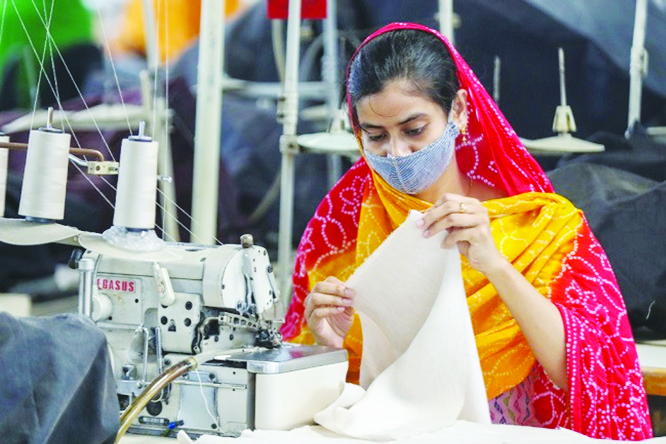

Md Tarek Hossain: Bangladesh's ready-made garment (RMG) sector has enjoyed a strong start to the year, with exports to the United States reaching $1.5 billion in just the first two months-January and February. This figure represents a remarkable 26.64 % increase compared to the same period last year. The country now holds a 9.5 % share of the US garment import market, cementing its position as one of the leading suppliers.
Among the top ten garment exporters to the United States, Bangladesh posted the highest growth rate during this period. However, despite the promising numbers, exporters are increasingly worried about the months ahead. The concern stems from recent policy changes under US President Donald Trump, who has imposed retaliatory tariffs on a range of imported goods, including garments from Bangladesh.
This sudden policy shift has unsettled both current and future business dealings. Exporters say that even orders that have already been finalised are now in a fragile state, with buyers expressing hesitation. Some have reportedly delayed shipments, while others are reconsidering or even withdrawing future orders. There is growing fear that starting from the upcoming summer season, the new tariffs could lead to a drop in demand from US buyers.
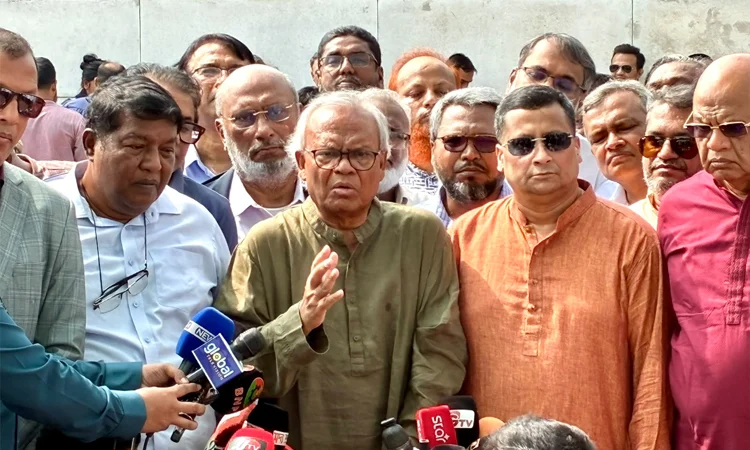
Mohammad Hatem, president of the Bangladesh Knitwear Manufacturers and Exporters Association (BKMEA), expressed serious concern over the development.
He said that orders ready for production might be postponed or cancelled altogether, while those in the negotiation stage could easily be shifted to other countries with lower tariffs. He also noted that many buyers have already placed orders for the winter season, which raises the possibility that the summer season may see a dip.
On 2 April, the Trump administration announced a 37 % retaliatory tariff on Bangladeshi garments-one of the highest rates among exporting nations. In comparison, tariffs on Indian products were set at 26 %, and on Pakistani goods at 29 %. Other affected countries include China, Vietnam, Indonesia, Honduras, Cambodia, and South Korea, each facing varying levels of new duties. Although Mexico was not hit with new tariffs this time, it had already been subjected to a 25 % tariff earlier in February.
According to updated data from the Office of Textiles and Apparel (OTEXA), part of the US Department of Commerce, the total value of US garment imports in January and February stood at $13.55 billion-an increase of 11.25 % year-on-year. The data also revealed that, alongside Bangladesh, India and Pakistan were the only other countries to record growth above 20 % in the same timeframe. Despite Bangladesh leading in growth, the heavier tariff burden could undermine its competitive advantage.
China remains the dominant player in the US garment market, with a 20.78 % share, exporting $2.77 billion worth of clothing in the first two months of the year. Vietnam follows closely behind, with $2.62 billion in exports. India, meanwhile, exported $960 million worth of garments, achieving a 25.7 % increase.
To make matters more complex, China has responded to the US tariffs with equal measures, imposing 34 % duties on American products, escalating the ongoing trade tensions into what many are calling a full-fledged trade war.
In this rapidly shifting trade environment, Bangladesh's exporters are left navigating uncertainty. While early-year figures show remarkable progress, there is an undeniable sense of anxiety about the future. If the high tariffs remain in place and global buyers begin to realign their sourcing strategies, Bangladesh's garment industry, which has long been a pillar of the national economy, could face significant headwinds in the months to come.