
Niaz Mahmud from New York
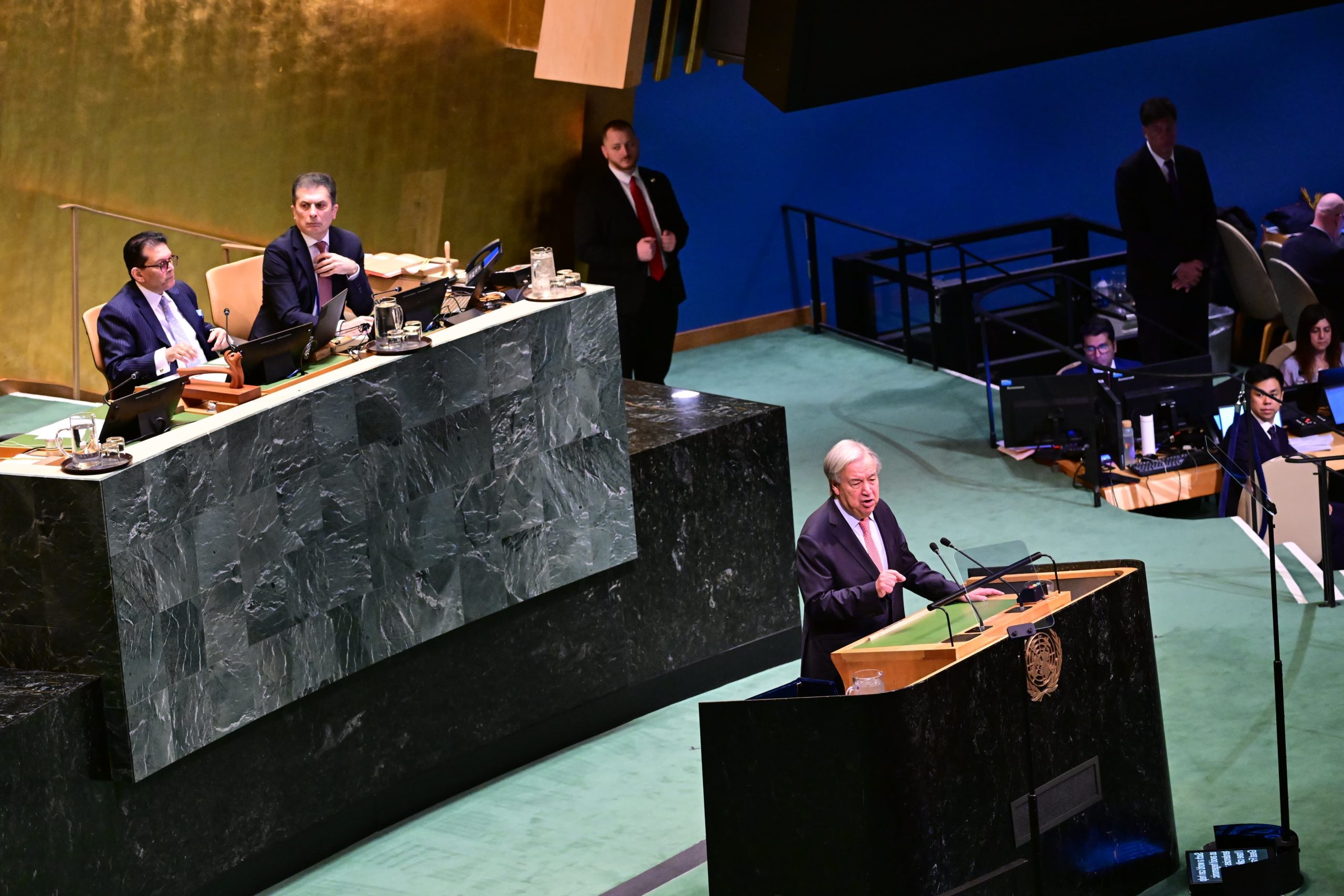
Humanity is facing four defining tests of power—war and peace, inequality, climate change and artificial intelligence—that will determine whether the world moves towards greater cooperation or deeper division, UN Secretary-General António Guterres warned the General Assembly.
With roughly 100 days remaining in his term, Guterres used his annual address to highlight what he described as a fundamental transformation in the way power is exercised around the world. He pointed to the emergence of new State powers, the growing influence of private corporations and individuals, and the expanding role of artificial intelligence and autonomous weapons in decisions once made exclusively by humans.
“The greatest power is not the power to dominate. It is the power to build a future that works for everyone,” Guterres said.
He warned that international divisions have continued to deepen over the past decade, citing attacks on civilians, the deaths of humanitarian workers, violations of international law and declining trust among nations.
“The faultlines in our world are widening,” he said. “Cracks have become canyons.”
Guterres called for stronger international cooperation based on shared rules and mutual dependence, warning against a world divided into rival economic and security blocs—a situation he has previously described as the “Great Fracture.”
Conflicts Continue to Test International Cooperation
Addressing conflicts in the Middle East, Ukraine, Sudan and Myanmar, Guterres argued that many purported ceasefires have failed to provide lasting protection for civilians.
On Gaza, he renewed his call for compliance with orders issued by the International Court of Justice and warned that continued settlement expansion in the Israeli-occupied West Bank could further undermine prospects for a two-State solution.
He also condemned Russia’s full-scale invasion of Ukraine as a violation of the UN Charter.
Guterres again called for reform of the United Nations Security Council, describing the absence of permanent African representation as “unjust and indefensible.” He argued that the Council’s current structure reflects a geopolitical landscape that is substantially different from the one that existed when the UN was founded.
Inequality Remains a Global Power Imbalance
Guterres also focused on the widening gap between global wealth and access to basic necessities.
Despite record levels of wealth worldwide, billions of people continue to lack adequate access to food, clean water, education and healthcare, he said.
He argued that inequality is fundamentally a question of power—particularly over resources, opportunities and the ability of people and nations to determine their own futures.
The Secretary-General renewed calls for faster debt relief for developing countries, stronger multilateral development banks and more equitable access to Special Drawing Rights issued by the International Monetary Fund.
He also connected the issue of inequality with climate change, noting that many developing countries face severe climate-related consequences despite having contributed relatively little to historical emissions.
UN Reports Gender-Parity Milestone
Guterres highlighted gender equality as another area in which international institutions can change entrenched power structures.
He announced that the UN had reached full gender parity across senior leadership, headquarters staff and professional positions for the first time in its history.
“Equality is not a dream; it is a decision,” he said, presenting the UN's progress as evidence that longstanding inequalities can be addressed through deliberate institutional action.
AI Governance Emerges as a Critical Challenge
Artificial intelligence formed another central element of Guterres’s warning about the changing nature of power.
He called for binding international cooperation on AI governance and stressed that decisions involving life and death should remain under meaningful human control.
The Secretary-General’s broader message was that technological advances, geopolitical shifts, economic inequality and armed conflict cannot be addressed separately. Instead, he argued, they require stronger international institutions and common rules capable of managing rapidly changing forms of power.
As his term approaches its final months, Guterres urged governments to reject the idea that global fragmentation is inevitable and instead strengthen cooperation to address challenges that increasingly cross national borders.