
Prime Minister’s Adviser Mahdi Amin today said Prime Minister Tarique Rahman’s government has ensured unprecedented freedom of expression and human rights over the past seven months after assuming office.
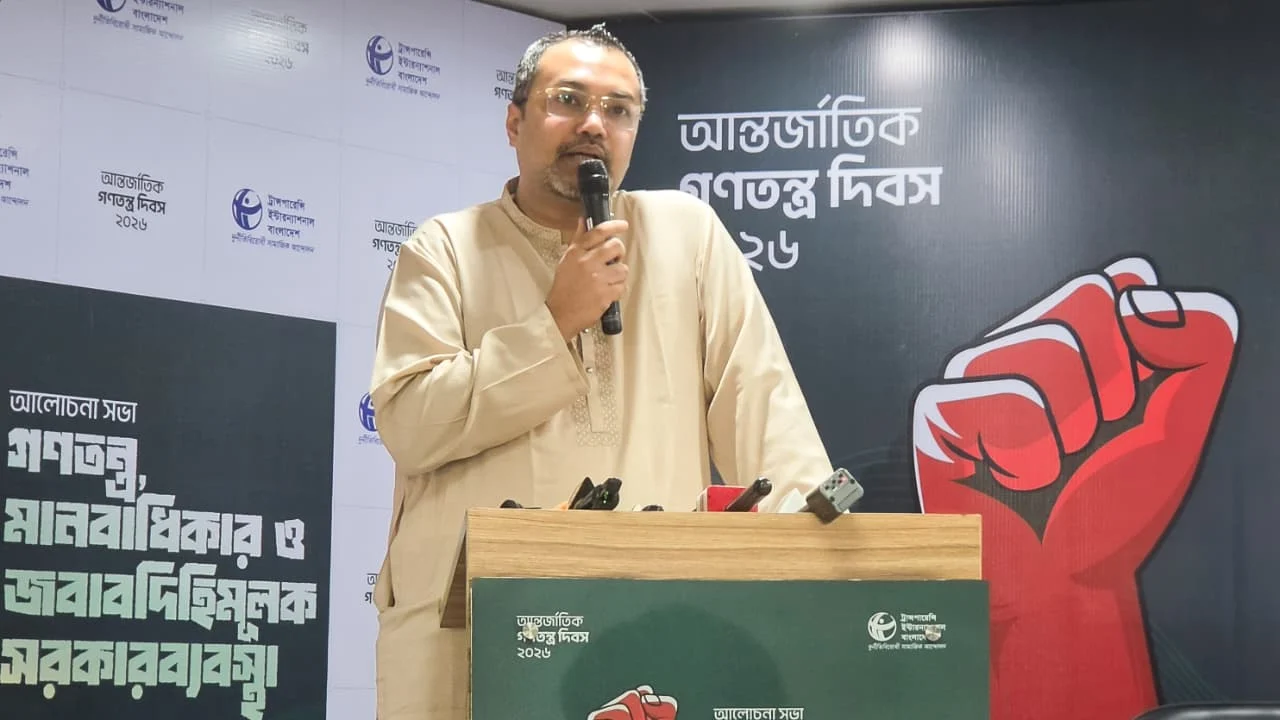
“Dismantling overnight the accumulated debris left behind by 17 years of fascist rule is a difficult task. However, the reality is that during these seven months of governance, there has been no state-sponsored violation of human rights anywhere in the country,” he told a TIB discussion in the capital’s Dhanmondi.
Transparency International Bangladesh (TIB) organized it on “Democracy, Human Rights and Accountable Governance” at its office.
The adviser said, “There have been no enforced disappearances, extrajudicial killings or deaths resulting from torture under state patronage. Nor has the dissent, political views, ideology or political values of opposition parties been suppressed with state backing.”
Amin, also Prime Minister’s Office spokesperson, said there has been no form of human rights violation in the democratic state system under state patronage or out of political vengeance.
He said in the past, lists of people holding opposing views were prepared from a particular government office or at the highest level of the state, followed by direct intervention through official orders.
If any isolated undesirable incident or administrative error occurs at the local level within the current democratic state structure, it is immediately brought under accountability, he said.
Amin said whenever a crime occurs, action is being taken as quickly as possible and the rule of law is being ensured.
The government wants to give this democratic process a permanent institutional form, he said.
If isolated irregularities occur at the grassroots level, the government is no longer covering them up as was done in the past; instead, investigations and corrective measures are initiated promptly as soon as information becomes available, he mentioned.
He said the culture of suppression and oppression from the centre is being dismantled, and complaints from marginalized people are now being given importance and acted upon.
“This is a positive change in the way the state is being governed,” he said, expressing hope that this transparency would be further strengthened in the coming days.

Speaking about the July mass uprising, Amin said the historic movement was not the movement of any particular political party or a specific section of society.
From students of schools, colleges, madrasahs and universities to garment workers, rickshaw pullers, expatriates, women, teachers, lawyers, doctors and journalists, people from all walks of life played an unprecedented role from their respective positions, he added.
He said a national unity had emerged in which everyone came together at one point in opposition to fascist rule.
Regarding consultation with stakeholders on various laws, the adviser said more than 100 ordinances issued by the previous interim government had been converted into full-fledged acts during the first session of the current parliament.
He said it was rare in the past to see such a large number of bills passed through the parliamentary process within such a short period.
However, he said that stakeholder opinions had been sought regarding the several new laws that were enacted, adding that the draft laws had been made public well in advance, he added.
“It should be remembered lawmaking is an ongoing process,” he said.
He said after 17 years of misrule, when an elected government began running the state, lawmakers were trying to incorporate the views of people from all sections of society.
“Perhaps, it is not possible to achieve 100 percent perfect change at the very first attempt. However, after receiving opinions from stakeholders at various levels, the government is also making necessary amendments wherever they appear to be practical,” he said.
Amin said the prime minister has given clear and direct instructions that close consultations should continue with those who can play a constructive role in making laws more people-friendly and practical.
He said the government firmly believes that ensuring the proper implementation of a law is far more significant than merely adhering to the letter of the law.
During the fascist period, people’s voting rights were taken away and human rights were trampled by misinterpreting various provisions of the Constitution, he said.
Therefore, while the language of a law is important, ensuring its humane interpretation and practical implementation is even more important, he said.
Amin said by upholding the core ideals and collective aspirations of the July uprising, Bangladesh is now experiencing the highest level of freedom of expression.
He said that even when indecent or offensive behaviour occurs in various situations, the government is maintaining the highest level of tolerance and peaceful coexistence.
He said the main objective of the mass uprising was to rise above narrow political thinking and ideology and work together, shoulder to shoulder, to build a new Bangladesh.
Noting that differences in political ideology or philosophy are natural, he said everyone must remain united and steadfast on issues concerning the broader national interest, independence and sovereignty.
He called upon all to prioritize the people, democracy and sovereignty under the principle of “Bangladesh First.”
At the same time, he described bringing different opinions and political approaches under one roof while placing the national interest above everything else as the true democratic aspiration.
Amin said the BNP has played an immense role in every crisis and democratic transition in Bangladesh’s history.
He said democracy was reborn in the country under the BNP following BAKSAL and the prolonged period of fascism.
He said following BAKSAL, Shaheed President Ziaur Rahman restored multiparty democracy; after the end of authoritarian rule, parliamentary democracy returned to the country under BNP Chairperson Begum Khaleda Zia; and following the end of prolonged fascist rule, Bangladesh has now returned to the democratic path under the visionary leadership of Prime Minister Tarique Rahman.
Amin said the government is working to establish a genuinely inclusive state system and balanced national development.
In this regard, independence, territorial integrity, sovereignty and democracy are being given the highest priority, he said.
He said today’s free and democratic Bangladesh is the result of a long and bloody struggle against fascism.
During the fascist period, more than six million BNP leaders and activists alone were subjected to false cases, while thousands of fellow activists were forcibly disappeared or killed.
He said every political party committed to democratic ideals had to endure such difficult sacrifices.
Amin further said the present government sincerely believes that the people of Bangladesh are the sole source of state power and the true owners of the state.
Therefore, he said, the BNP government is committed to governing the country with 100 percent accountability and full transparency to the people.
He said Bangladesh would move forward with civil society, the media, the private sector, and particularly young people and women serving as key driving forces.
One of the government’s priorities is to build a people-friendly and inclusive state by harnessing the immense potential and talent of the younger generation.
The adviser hoped through united efforts, Bangladesh would repay the debt owed to those who sacrificed their lives during the July Mass Uprising and attain the desired position of dignity on the global stage.
TIB Executive Director Dr. Iftekharuzzaman moderated the discussion while BNP International Affairs Secretary Barrister Muhammad Naushad Zamir, Bangladesh Samajtantrik Dal member Dr. Manisha Chakraborty, physician and youth politician Tasnim Jara, among others, also spoke.
Academics, senior journalists, representatives of civil society, young students from various educational institutions, and young members of different voluntary organizations were also present at the event.