

Over 15 years, the supply chain industry quietly reshaped the U.S. labor market
Md Emon Ahmed is originally from Bangladesh and currently resides in the United States. He holds a Master of Science in Business Analytics from Bernard M. Baruch College, The City University of New York (CUNY). His work mainly focuses on data-driven decision making, supply chain analytics, artificial intelligence, and sustainable industrial development. Email: emonbba1518@gmail.com
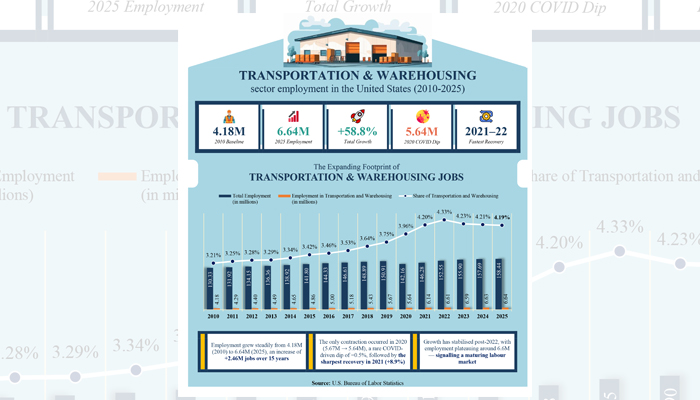
What began with iron tracks and shouted commands now runs on algorithms and speed. Over the past fifteen years, transportation and warehousing industries added 2.46 million jobs – an unglamorous but telling measure of how the American economy works.
The way we think about growth is changing – it's not just about making things, but also about how we get them to people. The U.S. Bureau of Labor Statistics data showed between 2010 and 2025, the number of jobs in this area went up by 58.8%, from 4.18 million to 6.64 million.
This is a big jump, and it's clear that the work of moving, storing, and delivering things is becoming more important.
An economy that cannot stand still
Few sectors reveal the true engine of an economy as plainly as transportation and warehousing. It sits beneath every other industry like an invisible infrastructure – carrying raw materials to factories, finished goods to store shelves, and parcels to front doors across the country. When it stalls, everything stalls. When it surges, the ripple is felt everywhere.
According to the U.S. Bureau of Labor Statistics, the sector encompasses an expansive range of subsectors: air, rail, water, road, and pipeline transportation; couriers and messengers; postal services; support activities for transportation; and warehousing and storage. This breadth means that a downturn in one mode is frequently offset by growth in another – a structural resilience that few sectors can claim.
The sector's economic significance extends well beyond raw job numbers. As of early 2026, average hourly earnings stand at $32.48 for all employees, reflecting meaningful wage growth as employers compete for skilled workers in a tightening labour pool.
Union members in the sector command considerably more – a median weekly wage of $1,432, compared to $1,018 for non-union workers – underscoring the sector's strong tradition of organisedlabour and collective bargaining.
A workforce that weathered the storm
Perhaps no single chapter in recent employment history is as telling as the COVID-19 disruption. In 2020, when virtually every sector contracted, transportation and warehousing recorded only a 0.5% dip – from 5.67 million to 5.64 million jobs. The contraction was so shallow it barely registered on the broader employment landscape.
What followed was extraordinary. In 2021, the sector exploded with an 8.9% growth rate, the sharpest single-year expansion in the entire 15-year dataset, adding hundreds of thousands of jobs as supply chains strained, e-commerce volumes surged, and a homebound public demanded more delivery than at any prior moment in history.
A further 7.7% growth followed in 2022, cementing the sector's role as one of the primary drivers of America's post-pandemic economic recovery.
By 2023, growth began to plateau – with a slight contraction of 0.3% –signaling what analysts describe as a maturing labour market. Employment has since stabilized around the 6.6 million mark, with March 2026 figures from the BLS recording approximately 6.55 million seasonally adjusted workers. This stabilisation does not indicate decline; it reflects a sector that has reached a new, higher equilibrium.
Where the jobs are – and where they are going
The BLS data reveals a workforce of remarkable diversity. Heavy and tractor-trailer truck drivers alone account for over 1.18 million jobs – the sector's largest single occupational category, with a median annual wage of $59,200.
Airline pilots and flight engineers number more than 93,000, with mean annual compensation exceeding $290,000. Railroad conductors, marine sailors, and ground transportation workers round out a sector that genuinely spans every mode of human movement.
Across the sector's more than 320,000 private-sector establishments, benefits coverage is robust: 88% of workers have access to employer-sponsored healthcare, 93% to paid vacation, and 87% to paid sick leave. Retirement benefit access stands at 87%, a figure well above many comparable sectors.
Looking forward, federal infrastructure investment has added fresh momentum. The Bipartisan Infrastructure Law directed tens of billions toward roads, bridges, ports, and freight rail – investments that directly translate into sustained demand for transportation and logistics workers across every geography and every mode.
The road ahead
The sector's trajectory points to continued relevance, even as automation and electrification reshape specific job functions. The rise of autonomous logistics, electric freight vehicles, and AI-powered warehousing will transform certain roles – but history suggests the sector adapts and grows.
Every technological shift in transportation, from the locomotive to the container ship to the delivery drone, has expanded the number of people the industry requires, not contracted it.
From a worker driving spikes into timber two centuries ago to a logistics coordinator orchestrating same-day deliveries across a metropolitan region today, the American transportation workforce has always been the country's most fundamental economic asset.