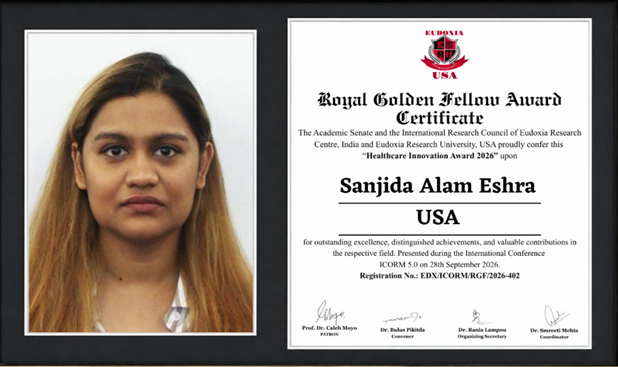

At the prestigious International Royal Golden Fellow Award 2026 Ceremony and Fifth International Conference on Recent Trends in Multidisciplinary Research 2026 ICORM 5.0 2026, held on 28th September (Monday) and 29th September (Tuesday), 2026,the selection committee reviewed numerous high-quality research submissions. Among these, the abstract submitted by Sanjida Alam Eshrawas recognized as exceptionally insightful and closely aligned with the conference theme. As a result, Sanjida Alam Eshrawas selected as one of the distinguished recipients of the Healthcare Innovation Award 2026, conferred by Eudoxia Research University, USA, and the Eudoxia Research Centre, India.
During the conference, Sanjida Alam Eshra presented research titled “Multimodal AI System for Early Cancer Detection through Integrating Imaging, Genomic Profiles, and Clinical Risk Indicators.” Her work examines how integrating medical imaging, genomic information, and clinical risk factors through AI could support earlier cancer identification and more informed risk assessment. Her Business Analytics background informs the study’s emphasis on bringing diverse health data together for precision medicine. With participation from delegates representing more than five countries and awards presented across multiple categories, the event brought together esteemed scholars, scientists, academicians, and professionals from around the world. Sanjida Alam Eshra’s research highlights a promising interdisciplinary approach to improving cancer detection and supporting future clinical decision-making.
Sanjida Alam Eshra’s research contribution focuses on a multimodal analytical approach that considers imaging, genomic profiles, and clinical risk indicators together rather than in isolation. By exploring how these complementary sources may inform cancer risk assessment, the study offers a foundation for future AI-assisted screening and precision oncology research. Its potential benefits include more informed clinical assessments and improved identification of high-risk patients, subject to independent validation, careful attention to data quality, and appropriate clinical oversight.
The award selection process for ICORM 5.0-2026, was overseen by an internationally recognized Central Organizing Committee, comprising distinguished scholars and institutional leaders. Key members included: Chief Patron: Prof. Dr. Rhituraj Saikia, President, Eudoxia Research University, USA Patron: Prof. Dr. Caleb Moyo, VC, Eudoxia Research University, USA Convener: Prof. Dr. Pratisha Kumari, VP & MD, Eudoxia Research University, USA Dr. Bulus Pikitda, Nigeria, Dean (Humanities), ERU - USA Organizing Secretary: Dr. Rania Lampou, Greece, Dean (Aca & Res) ERU – USA Dr. Bipin Kumar Shah, Director Outreach, Eudoxia Research Centre, Mumbai, India Coordinator: Dr. Smreeti Mehta, Registrar, Eudoxia Research University, USA Absa Burhan, European Institute of Management and Technology, Switzerland.
Submissions were evaluated based on originality, professional impact, innovation capacity, sustainability focus, and contribution to global competitiveness. Sanjida Alam Eshra’s work was recognized for its interdisciplinary relevance and its potential to advance data-driven approaches to an important healthcare challenge. HerICORM 5.0-2026 recognition at Sanjida Alam Eshra’s research addresses an important global healthcare priority: improving opportunities for early cancer detection. Internationally, integrating multiple types of patient information may inform future work on more accessible and reliable screening. In the United States, this research direction is relevant to precision oncology and the responsible development of clinical decision-support tools. In Bangladesh, where access to specialist diagnostics may be uneven, validated and affordable approaches could eventually strengthen screening and referral decisions. The Healthcare Innovation Award recognizes the promise of her interdisciplinary research and her commitment to advancing AI-enabled healthcare. These are potential applications, not established clinical outcomes.