
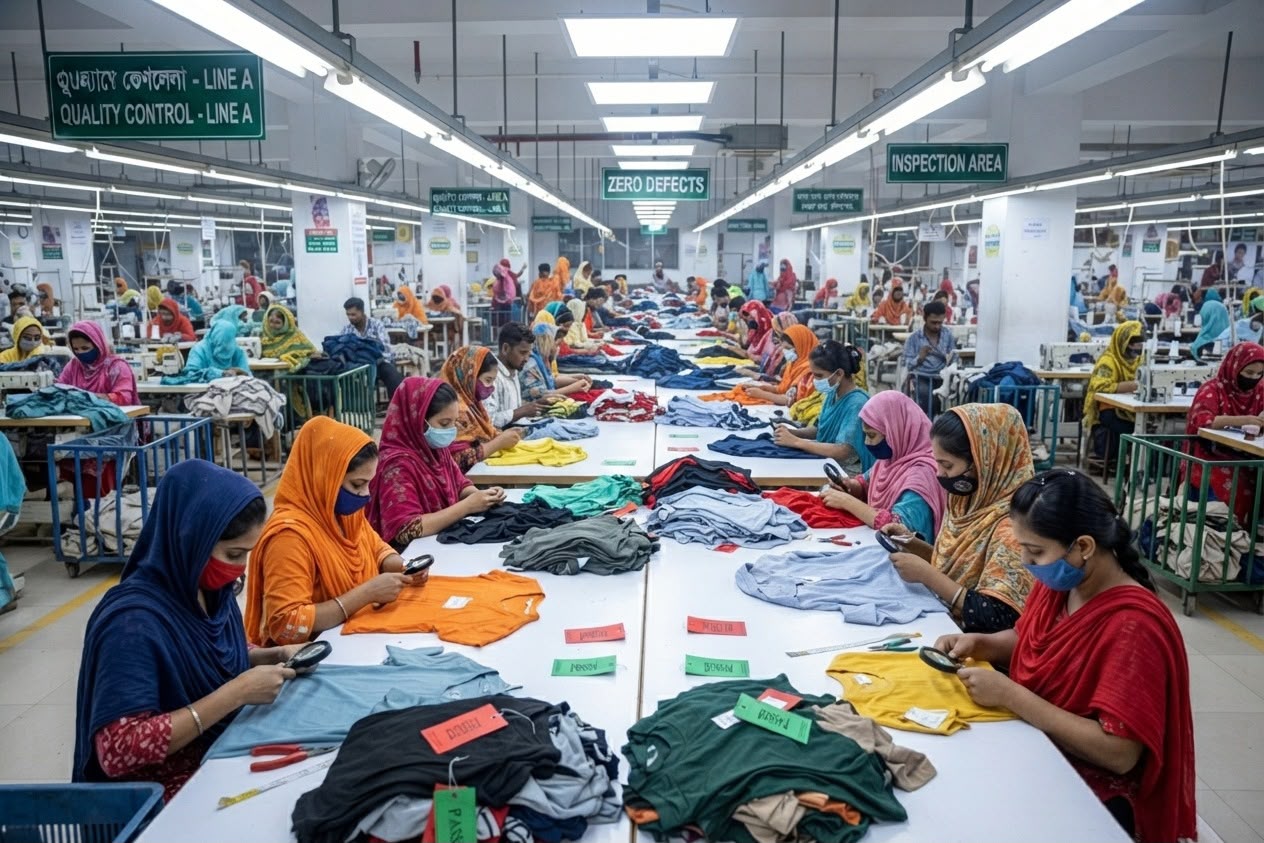

The widening gap between international retail prices and factory export earnings highlights the need for transparent pricing, fair purchasing practices and better returns for Bangladeshi manufacturers.
DHAKA: As garment prices continue to rise in international markets, a critical question is emerging for Bangladesh’s readymade garment (RMG) industry: how much of the final retail price actually reaches the factories that manufacture these products?
A garment displayed in an international fashion brand’s showroom or sold through an online platform often carries a retail price significantly higher than the amount paid to the manufacturing factory. Although this difference is a common feature of the global apparel supply chain, the distribution of value among manufacturers, brands, retailers and intermediaries deserves closer scrutiny.
The final retail price of a garment reflects much more than its manufacturing cost. International transportation, customs duties, insurance, warehousing, marketing, brand management, retail operations and other commercial expenses all contribute to the price consumers ultimately pay.
Consequently, the export price received by a Bangladeshi manufacturer can be substantially lower than the retail price charged by an international brand. However, the key issue is how much value remains with the factory after accounting for production expenses and other operational costs.
For Bangladesh, where the garment industry remains heavily dependent on international buyers and export orders, understanding this pricing gap is particularly important.
A direct comparison between the retail prices of similar garments, however, may not provide an accurate picture of manufacturers’ earnings. Differences in fabric quality, design, raw materials, production complexity, order quantities and sourcing conditions can significantly influence export prices. Even products sold under the same international brand may have different prices across markets.
A meaningful assessment therefore requires examining individual product specifications alongside factory Free on Board (FOB) prices, production costs, export invoices and the terms of international purchase orders. Such an analysis would help establish how much manufacturers actually receive for each order and how that amount compares with the final retail value.
Another pressing concern is whether international buyers are adjusting their purchasing prices in response to rising production costs in Bangladesh.
Higher wages, electricity and gas tariffs, transportation expenses, bank interest rates and other operational costs have placed additional financial pressure on garment manufacturers. Yet, the extent to which these increased expenses are reflected in the prices offered by international buyers remains a significant concern for the industry.
When manufacturers are expected to absorb rising production costs while continuing to supply products at unchanged purchasing prices, their profit margins inevitably come under pressure. This can undermine their ability to increase workers’ wages, improve workplace conditions, invest in modern technology and adopt environmentally sustainable production practices.
Industry stakeholders believe that greater transparency in the global apparel supply chain is essential to understanding this imbalance. A comprehensive assessment of international purchase orders, factory FOB prices, production cost breakdowns, export invoices and corresponding retail prices could provide a clearer picture of how value is distributed across the industry.
Fair purchasing practices also need to become a central part of discussions on the future of Bangladesh’s garment sector. Manufacturers require adequate financial resources to ensure fair wages, maintain workplace safety, improve compliance and invest in environmentally responsible production.
If international buyers expect suppliers to meet increasingly demanding labour, social and environmental standards, the additional costs of compliance should be appropriately reflected in purchasing prices. Otherwise, manufacturers may face growing financial obligations without receiving adequate returns for their investments.
An excessive focus on sourcing garments at the lowest possible prices could further weaken factories, particularly those operating with narrow profit margins. In the long run, this may threaten the sustainability of suppliers and disrupt